Executives do not want another spreadsheet. They want a clear answer: is human risk going down, and what happens next? Request a demo to see how Living Security turns human risk data into board-ready reports in seconds.
Most security teams spend hours exporting charts, building slides, and writing executive summaries before every board meeting. That effort rarely survives first contact with the audience. Boards ask different questions than security teams expect, and the data is not organized around the decisions they actually make.
Human Risk Management (HRM), as defined by Living Security, is the practice of measuring, managing, and reducing human risk across behavior, identity and access, and threat exposure. AI-powered reporting makes HRM results visible to leadership by converting raw risk data into executive summaries, audit-ready snapshots, and recurring reports that can be delivered automatically.
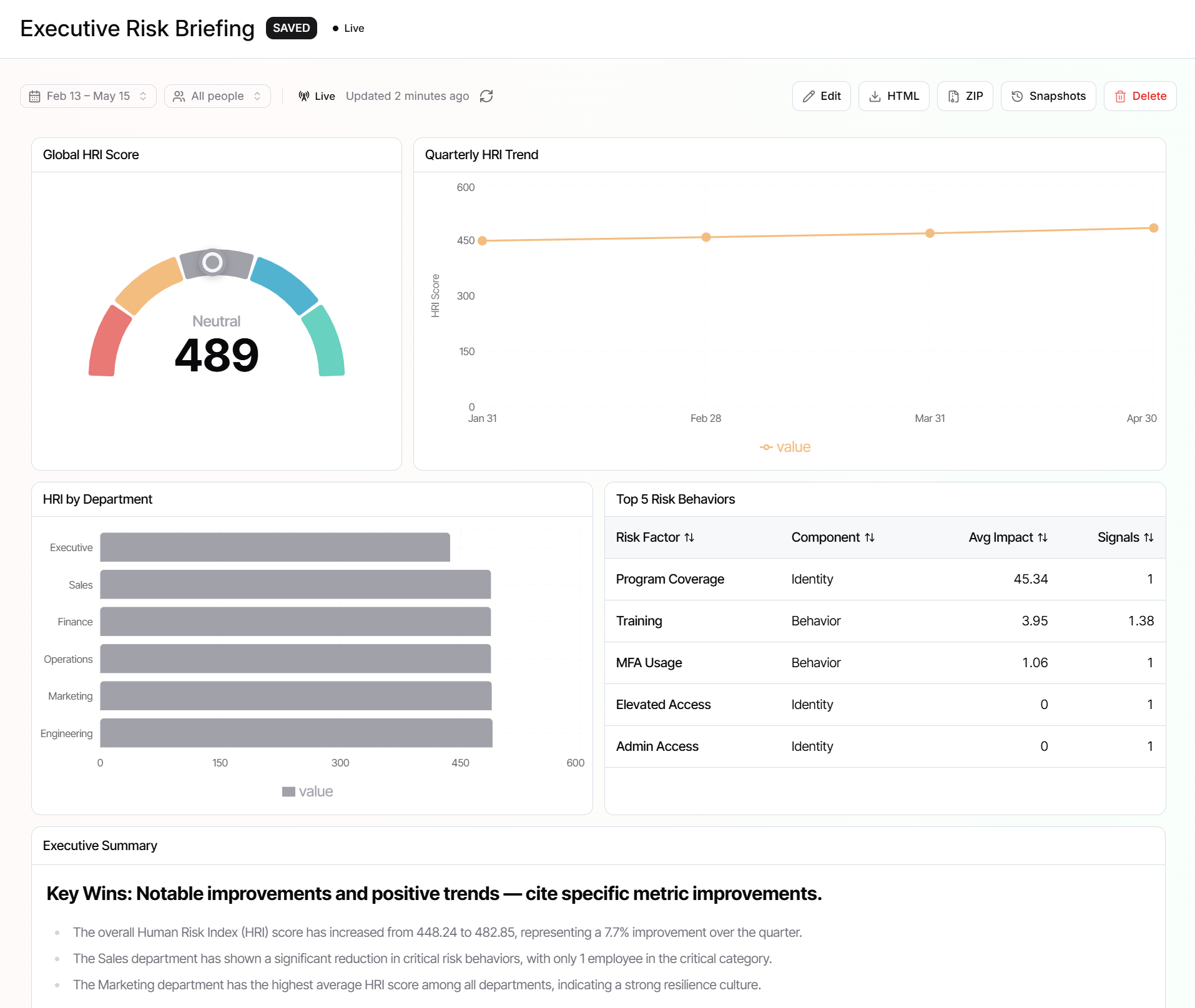
Living Security, a leader in Human Risk Management (HRM), built Livvy, an AI intelligence engine, to remove the reporting bottleneck. Livvy generates board-ready Human Risk Management reports from simple natural-language prompts, selects the most relevant risk metrics and visualizations, and writes summaries in business language instead of security jargon.
Why Do Security Teams Struggle to Report Human Risk?
Human risk data is scattered across phishing simulations, identity systems, security tools, and training platforms. Each source records different events with different formats. Pulling the data together into a single executive view is a manual process that consumes analyst time and produces inconsistent results.
The core problem is not data volume. It is context. A raw metric such as "38% of users failed a phishing simulation" means nothing without knowing which users matter most, what access they hold, and whether the risk is rising or falling. Executives need that context translated into decisions: where to invest, what to change, and how to measure progress.
How Does Livvy AI Create Board-Ready HRM Reports?
Livvy is built to explain, not just display. When a security leader asks a question in plain language, Livvy pulls the relevant human risk data, runs a multi-step analysis, and constructs a report that connects the numbers to the business outcome.
- Natural-language prompts. A CISO can ask questions such as "Show me the highest-risk cohorts" or "Summarize our quarterly risk reduction" and receive a complete report without building a single chart.
- Automatic metric selection. Livvy chooses the risk metrics and visualizations that matter for the question asked, instead of presenting every signal the platform tracks.
- Executive summaries in business language. Livvy translates security outcomes into terms executives already use, such as risk reduction, exposure, and program effectiveness.
- Audit-ready snapshots. Each report captures the state of human risk data at a point in time, giving compliance teams a defensible record of what was measured and when.
See Livvy build a board-ready report from a single question. Watch the demo video or request a demo to try it with your own data.
What Should a Board-Ready Human Risk Report Include?
A board-ready report answers three questions: What is our exposure? Is it improving? What are we doing about it? Every section of the report should map to one of those three questions, with a metric, a trend, and a next step.
- Executive summary. A two-to-three paragraph statement of overall human risk, written in business language, with the single most important number up front.
- Risk trend by pillar. A view of behavior, identity and access, and threat exposure over time, so the board can see whether the program is moving risk in the right direction.
- Highest-risk segments. A breakdown of the users, roles, or departments contributing the most risk, with plain-language reasoning for why they matter.
- Intervention impact. The results of training, nudges, and policy changes, tied to the risk reductions they produced.
- Audit trail. A snapshot of the underlying data and methodology, so the report can be defended in an audit or to a regulator.
Where Do Human Risk Reports Come From in Traditional Programs?
Traditional security awareness training programs report completion rates. They measure whether employees watched a video or passed a quiz, not whether risky behavior changed. That gap is why boards discount training metrics: completion is an activity, not an outcome.
Human Risk Management software replaces completion-based reporting with outcome-based reporting. The platform continuously evaluates behavior, identity-related risk, and threat exposure, then measures how those signals change as interventions are applied. The result is a report that demonstrates measurable risk reduction instead of a percentage of finished modules.
How Can CISOs Use Automated Reporting to Prove Risk Reduction?
The most valuable thing a CISO can bring to a board is a trend line that turns upward in the right direction. Livvy AI helps CISOs create that evidence by automating the reporting workflow end to end.
- Reduce reporting time. Reports that took days to assemble can be generated in seconds, freeing analysts for investigation and response.
- Improve consistency. Every report follows the same structure, metrics, and definitions, so the board compares like with like each quarter.
- Automate delivery. Reports can be sent to stakeholders through email, Slack, and Microsoft Teams on a schedule, keeping executives informed between meetings.
- Scale to multiple audiences. The same underlying data can be summarized for the board, the risk committee, and individual business units without rebuilding the analysis.
Automating routine remediation is a separate benefit of the same platform. When risk signals spike, automated nudges and policy enforcement respond immediately while the security team stays in control. That combination, prediction plus automated action, is what moves human risk programs from reactive to proactive.
Frequently Asked Questions
What is a board-ready human risk report?
A board-ready human risk report is a concise summary of an organization's human risk exposure, written for executives, that shows current risk, trends over time, and the impact of security interventions.
How does Livvy AI generate reports?
Livvy AI converts natural-language prompts into complete Human Risk Management reports by selecting relevant risk metrics, generating executive summaries, and building visualizations from the platform's human risk data.
Can human risk reports be automated?
Yes. The Living Security Platform can generate and deliver human risk reports on a schedule through email, Slack, and Microsoft Teams, capturing audit-ready snapshots of the underlying data.