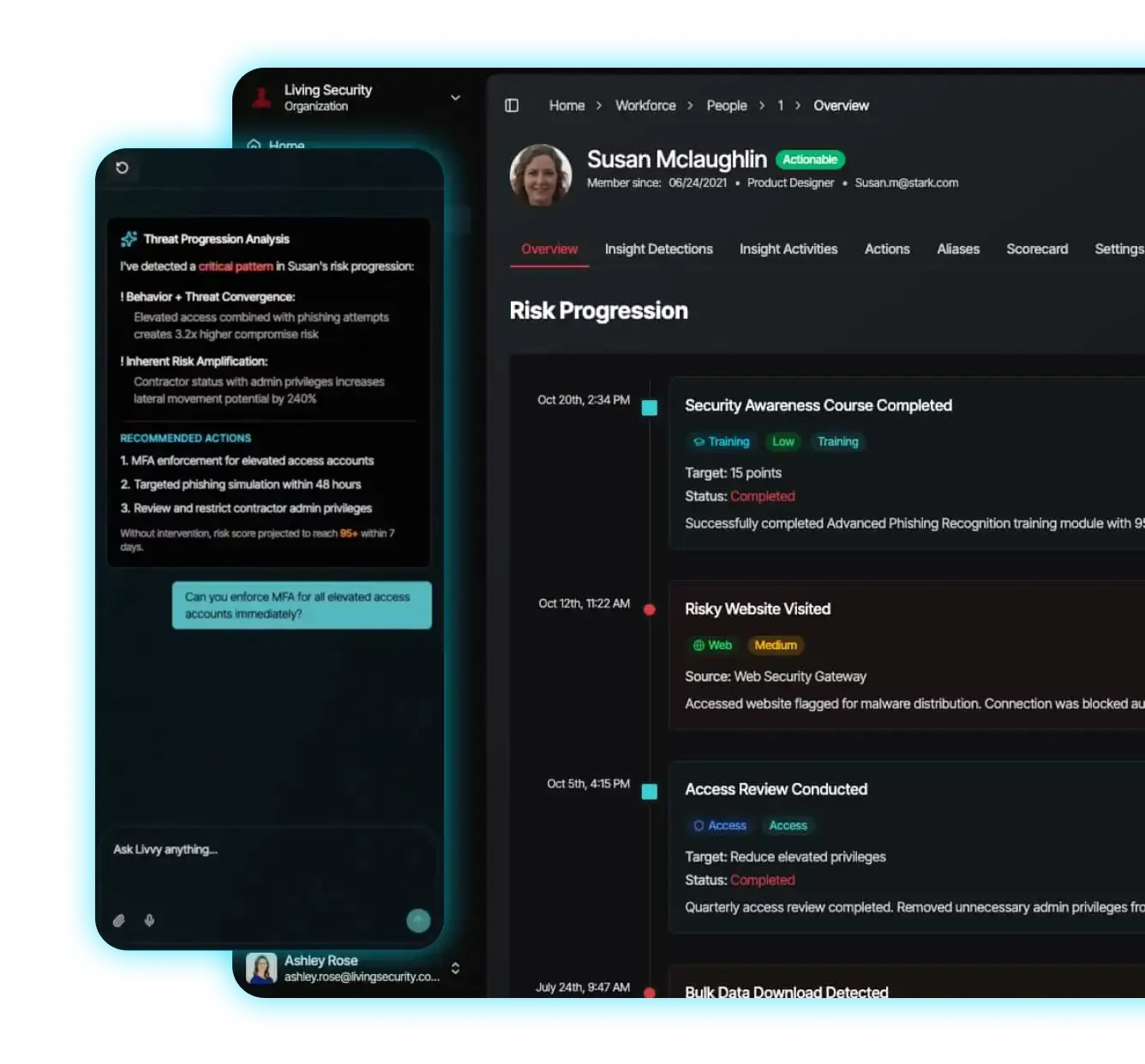
Instead of viewing generative AI solely as a threat, what if you could harness its power to build a more resilient defense? The most forward-thinking security leaders are doing just that. They are using AI to fight AI, moving beyond a reactive posture to build a predictive security program. This approach involves using AI to automate threat simulations, detect anomalies with greater precision, and train security models on synthetic data without exposing sensitive information. This is the core of a modern strategy for AI cybersecurity for generative AI applications. The leading Human Risk Management (HRM) platform from Living Security provides the foundation for this shift, enabling you to predict where risk will emerge and act decisively to prevent incidents.
Key Takeaways
- Generative AI creates new risks and new defenses: Attackers use it for sophisticated phishing and malware, while security teams can leverage it to predict threats and automate responses. An effective strategy must address both sides of this technological shift to stay ahead.
- Shift from reactive detection to proactive prediction: The scale of AI-driven attacks makes traditional security insufficient. A predictive approach, which correlates data across behavior, identity, and threat intelligence, is essential for identifying and neutralizing risks before an incident occurs.
- Manage risk across both humans and AI agents: A comprehensive security strategy must extend beyond people to include the AI agents they use. This requires a Human Risk Management (HRM) framework that establishes clear governance, provides continuous training, and maintains human oversight to secure the entire enterprise.
What is generative AI (and why does it matter for security)?
Generative AI is a type of artificial intelligence that creates new and original content. Unlike traditional AI that analyzes existing data, generative AI produces text, images, code, and sounds that have never existed before. It accomplishes this using advanced methods like Generative Adversarial Networks (GANs) and large language models (LLMs). While this technology opens doors for innovation and efficiency, it also introduces a new class of security challenges that every CISO and security leader needs to understand.
The same capabilities that allow generative AI to write an email or design a logo can be used for malicious purposes. The technology can be exploited to create highly convincing phishing emails, generate realistic but fake identity documents, or produce misleading information and deepfakes at scale. This fundamentally changes the threat landscape, making it harder for both people and traditional security tools to distinguish between legitimate and malicious content. For security teams, this means the old "detect and respond" model is no longer sufficient. You must adopt a proactive stance to get ahead of these emerging, AI-driven threats.
How generative AI works
At its core, generative AI uses sophisticated machine learning models to produce new information. These models are trained on vast datasets, allowing them to learn patterns, structures, and styles. When given a prompt, the model uses this learned knowledge to generate a unique output, whether it's a block of code or a photorealistic image. In a security context, this same process can be turned into a defensive tool. Security professionals can use these models for predicting, identifying, and mitigating online threats, which helps strengthen an organization's overall security posture. By understanding how attackers might use generative AI, you can build better defenses against them.
Generative AI in the enterprise
Within an enterprise, a strong security culture starts with an effective training program designed to change employee behavior and reduce human-layer risk. This is where generative AI can become a powerful ally for security teams. Instead of using generic, one-size-fits-all training modules, generative AI can help you create tailored content that addresses the specific threats your organization and employees face. A cybersecurity awareness training program becomes far more effective when it’s relevant and engaging. By simulating realistic, AI-generated phishing attacks or creating personalized micro-training based on an employee's role and risk profile, you can build a more resilient workforce prepared for modern threats.
How generative AI impacts cybersecurity
Generative AI is a double-edged sword in cybersecurity. For every defensive advantage it creates, attackers find a new way to exploit the same technology. This technology uses machine learning models to create new content, from text to images, and its application in security is fundamentally changing the threat landscape. For security leaders, understanding this dual impact is the first step toward building a resilient defense. It’s not just about adopting new tools; it’s about preparing for a new class of threats aimed at both your people and your systems.
Using generative AI for defense
On the defensive side, generative AI helps security teams become more predictive. Instead of just reacting to alerts, you can use AI to analyze massive datasets and spot the subtle, unusual patterns that signal an emerging threat. This allows your systems to react faster and learn from new attack vectors as they appear. A key application is creating high-quality synthetic data. This lets you train your security models to recognize threats without ever exposing sensitive company or customer information, a huge step forward for privacy and security. By leveraging these capabilities, your team can stay ahead of attackers and prevent incidents before they cause damage.
How attackers use generative AI
Unfortunately, attackers have access to the same powerful tools. They use generative AI to automate and scale their efforts, creating incredibly convincing phishing emails or novel malware variants in seconds. These AI-powered attacks can bypass traditional security controls and are often sophisticated enough to fool even savvy employees. Attackers can also target your AI models directly through methods like data poisoning, where they intentionally feed the model bad information to corrupt its decision-making process. This new wave of threats makes a proactive approach to Human Risk Management more critical than ever, as both human and AI-driven vulnerabilities are now part of your attack surface.
What are the risks of generative AI?
While generative AI presents incredible opportunities for innovation and efficiency, it also introduces a new and complex set of security risks. Attackers are rapidly adopting these same tools to create more sophisticated, scalable, and evasive threats. They can now generate convincing phishing content, create polymorphic malware, and use deepfakes for social engineering with unprecedented ease. This shift means that traditional, reactive security measures are no longer sufficient.
Understanding these risks is the first step toward building a resilient defense. The threats are not just technical; they are deeply intertwined with human behavior and, increasingly, the behavior of non-human AI agents. An effective security strategy must therefore account for the entire spectrum of risk, from an employee clicking a cleverly crafted phishing link to a compromised AI agent accessing sensitive data. Proactively managing this expanded threat landscape requires a new approach, one grounded in predicting and preventing incidents before they happen. This involves making risk visible across your entire organization, including both human and AI actors, and implementing targeted controls to mitigate it.
Advanced phishing and social engineering
Generative AI has supercharged social engineering, making it one of the most significant risks for enterprises. Attackers can now use AI to create highly personalized and grammatically perfect phishing emails, text messages, and even voice calls at a massive scale. These AI-generated campaigns can mimic the writing style of a trusted colleague or CEO, making them incredibly difficult for employees to identify. As the technology advances, we'll see more advanced phishing attacks that are context-aware and can carry on believable, multi-part conversations. This dramatically lowers the barrier for cybercriminals to launch sophisticated campaigns, turning every employee into a potential target and making robust phishing simulations more critical than ever.
Deepfakes and synthetic identity fraud
Deepfakes, which are hyper-realistic fake videos or audio clips created with AI, pose a severe threat to enterprise security. Imagine an attacker using a deepfake of your CEO’s voice to call the finance department and authorize a fraudulent wire transfer. This type of synthetic identity fraud is difficult to detect with traditional methods because it preys on human trust. Beyond financial fraud, attackers can use deepfakes to spread disinformation, damage a brand’s reputation, or impersonate executives to gain access to sensitive information. As this technology becomes more accessible, organizations must prepare for a new wave of attacks that blur the line between reality and digital fabrication, making employee education on verification essential.
Automated malware generation
Generative AI gives attackers the ability to create malicious software automatically and with great sophistication. Cybercriminals can use AI models to generate polymorphic malware, which is code that constantly changes its structure to evade detection by traditional antivirus and security software. This means even less-skilled attackers can now develop and deploy advanced threats that were once the domain of elite hacking groups. The ability to create harmful software on the fly makes signature-based detection increasingly obsolete. Defending against this requires a more dynamic, behavior-based approach to threat detection that can identify malicious actions regardless of the code's appearance.
Data poisoning and model manipulation
One of the most insidious risks of generative AI is data poisoning. This occurs when an attacker intentionally feeds malicious or biased information into an AI model during its training phase. By doing so, they can corrupt the model's learning process, causing it to make flawed decisions, produce inaccurate outputs, or create security vulnerabilities. For example, an attacker could poison the data used to train a security tool, teaching it to ignore a specific type of malware. This type of attack is stealthy and can undermine the integrity of the entire AI system, turning a defensive tool into a liability without anyone realizing it until it's too late.
Prompt injection and jailbreaking
Prompt injection is an attack where a malicious user crafts an input to trick an AI model into ignoring its safety protocols or original instructions. A similar technique, known as jailbreaking, aims to bypass the model's built-in ethical and safety filters to generate restricted or harmful content. For example, an attacker could use a prompt injection attack on an AI-powered customer service bot to extract sensitive user data from a backend database. These attacks exploit the way models interpret natural language, turning the model's flexibility into a security vulnerability. As organizations integrate generative AI into their workflows, they must implement strong input validation and monitoring to prevent bad actors from tricking AI models.
AI agent and non-human risk
As enterprises deploy autonomous AI agents to handle tasks, a new category of risk emerges: non-human risk. These AI agents, which can create new content and take actions on their own, become part of the digital workforce and, consequently, part of the attack surface. If an AI agent with privileged access to corporate systems is compromised or manipulated, it could lead to a large-scale data breach or system disruption at machine speed. Securing the enterprise now requires extending visibility and controls beyond human users to these non-human actors. A comprehensive Human Risk Management platform is essential for monitoring the complex interactions between humans and AI agents to predict and prevent incidents across the entire organization.
How to use AI to defend against AI threats
Fighting AI-driven attacks requires a security strategy that also leverages AI. Instead of waiting for an incident to happen, you can use AI to predict and prevent threats before they materialize. This proactive stance moves your security posture from reactive to preventative, giving you a critical advantage against sophisticated adversaries. An effective AI defense strategy integrates deep data analysis, automated simulations, and intelligent response mechanisms that cover your entire digital environment.
By using AI to defend against AI, you can automate threat detection at a scale and speed that is impossible for human teams alone. This approach involves training security models on diverse datasets, running continuous attack simulations to find weaknesses, and automating routine responses to contain threats instantly. Crucially, this strategy must also extend visibility to the AI agents operating within your systems, treating them as part of the human-machine teams that define the modern enterprise. The goal is to build a resilient defense that learns and adapts as quickly as the threats it faces.
Detect threats across behavior, identity, and threat signals
To accurately predict and prioritize risk, you need to see the whole picture. Relying on a single data source, like employee behavior, provides an incomplete view that can lead to false positives and missed threats. A truly effective approach requires correlating signals across multiple domains. The leading Human Risk Management platform from Living Security analyzes over 200 indicators across employee behavior, identity and access systems, and real-time threat intelligence.
This comprehensive analysis allows you to connect the dots between a user’s actions, their level of access to sensitive systems, and active threats targeting them or their role. For example, you can identify an employee who is clicking on phishing links, has privileged access to critical data, and is being targeted by a known threat actor. This correlated insight allows you to pinpoint your most significant risks and apply targeted interventions where they will have the most impact.
Train security models with synthetic data
One of the biggest challenges in training AI security models is getting enough high-quality data without compromising privacy. Generative AI offers a powerful solution by creating synthetic data, which is artificial data that mimics the statistical properties of real-world data. This allows you to train your security models on vast and varied datasets without ever exposing sensitive employee or customer information.
Using synthetic data helps you build more robust and accurate models capable of identifying novel attack patterns. For instance, you can generate realistic but fake examples of new malware variants or sophisticated phishing emails to train your detection systems. This prepares your defenses for threats that may not even exist yet, ensuring your models are resilient and can adapt to the rapidly changing threat landscape without putting real data at risk.
Automate threat simulation and anomaly detection
The best way to test your defenses is to challenge them continuously. Generative AI can automate this process by creating realistic, AI-powered attack simulations. These simulations can mimic the advanced social engineering and phishing campaigns that attackers use, allowing you to identify vulnerabilities in both your technical controls and your team’s security awareness. By running these tests automatically and at scale, you can get a constant reading on your organization’s readiness.
Beyond simulations, AI excels at anomaly detection. By establishing a baseline of normal activity for both human users and AI agents, security models can instantly flag unusual behaviors that may indicate a compromise. For example, an AI can detect when a user account suddenly starts accessing files at an unusual time or from a new location. This allows your security team to investigate potential threats much faster than with manual analysis, stopping attacks in their early stages.
Automate responses with human oversight
Speed is critical when responding to a security threat. AI-powered systems can automate initial response actions in milliseconds, far faster than a human operator. This includes actions like blocking a suspicious IP address, isolating a potentially infected device, or triggering a targeted micro-training for an employee who just made a risky click. Living Security’s platform can autonomously execute 60% to 80% of these routine remediation tasks.
However, full automation isn't the goal. The most effective strategy combines AI’s speed with human expertise. This "human-in-the-loop" approach ensures that a security professional is always in control. The AI handles the initial, high-volume work, while your team is freed up to focus on complex investigations and strategic decision-making. This creates a powerful partnership where AI with human oversight provides both speed and intelligent control.
Monitor both AI agents and human actors
As enterprises integrate more AI agents and applications, the attack surface expands. These non-human actors can become targets or even unwitting accomplices in a security incident. A forward-looking security strategy must therefore include monitoring the behavior of both your human workforce and the AI agents they use. This means extending visibility to understand how AI tools are accessing data, interacting with other systems, and executing tasks.
By applying the same principles of Human Risk Management (HRM) to AI agents, you can detect anomalous behavior that might indicate a compromise or misuse. For example, you can monitor for an AI agent that begins accessing data outside its normal operational parameters. This holistic view of human and machine activity is essential for securing the modern, hybrid workforce and ensuring that your AI security awareness efforts cover every actor in your environment.
How does machine learning secure generative AI?
Securing generative AI isn't about building taller walls; it's about building a smarter, more adaptive defense. Machine learning is the core of this modern approach. Instead of relying on static rules and known threat signatures that only address past attacks, machine learning models analyze data to understand, predict, and adapt to new risks as they emerge. This allows security teams to move from a reactive posture, where they are always one step behind, to a proactive one that addresses potential issues before they become incidents. By leveraging machine learning, you can create a security framework that learns and evolves alongside the technology it’s designed to protect.
This shift is fundamental to Human Risk Management (HRM), which focuses on making risk visible and measurable. The leading Human Risk Management Platform from Living Security uses machine learning to analyze over 300 signals across three critical data pillars: employee behavior, identity and access systems, and real-time threat intelligence. By correlating these disparate sources, the platform provides a comprehensive view of risk that accounts for both human and non-human actors, like AI agents. This data-driven approach moves beyond simple awareness training. It provides security teams with actionable visibility into risk trajectories, enabling them to predict where the next incident is most likely to occur and intervene with precision. This is how organizations can effectively manage the complex intersection of human and machine-driven risk in the enterprise.
Predict threats, don't just detect them
The old model of cybersecurity was to wait for an alarm to go off. The new model, powered by machine learning, is to predict when and where a threat might materialize. By analyzing massive streams of data, including user behavior, identity logs, and threat intelligence, machine learning can identify the subtle patterns that signal an impending attack. This proactive approach helps you find and stop new online attacks before they can cause damage. Instead of just detecting a data leak as it happens, a predictive model can flag the risky configurations and behaviors that make a leak possible in the first place. This gives your security team the chance to intervene with targeted training or policy adjustments, effectively neutralizing the threat before it escalates.
Adapt risk models with continuous learning
Threats are not static, and your defenses shouldn't be either. Machine learning models excel at continuous learning, constantly refining their understanding of what constitutes normal activity within your organization. By learning from past security data, a generative AI system can establish a dynamic baseline for user and system behavior. It can then flag anything that looks different as a potential security problem, catching anomalies that rule-based systems would miss. This adaptive capability is crucial for defending against novel attacks and internal threats. It ensures your risk models evolve as your organization and the threat landscape change, which is a core principle of an effective Human Risk Management program.
Test model robustness with adversarial training
How do you know if your AI security model is truly effective? You attack it. This is the principle behind adversarial training, a technique where you intentionally challenge your model with simulated attacks to find and fix its weaknesses. This process is essential for proactive risk management, as it teaches the AI to resist malicious inputs and sophisticated evasion techniques. By continuously testing your model's robustness, you can harden it against real-world threats like data poisoning or prompt injection attacks. This ensures your generative AI applications are not just intelligent, but also resilient and secure by design, ready to withstand the challenges they will face in a complex threat environment.
How to build an AI security training program
Traditional, one-size-fits-all security training is no longer sufficient. With generative AI creating new attack vectors, your program must evolve to address these specific risks. Building an effective AI security training program means moving beyond annual compliance exercises and creating a continuous, behavior-focused initiative that turns your employees into an active line of defense. The goal is to change behavior and reduce human-layer risk, not just check a box. When done well, this training transforms your workforce from a potential liability into a powerful security asset.
An effective program is a core component of a larger Human Risk Management (HRM) strategy. It should be data-driven, tailored to the threats your organization faces, and designed to give your people the skills they need to identify and resist sophisticated, AI-powered attacks. By integrating security awareness and training into your daily operations, you can build a resilient culture that works in tandem with your technical safeguards. This proactive approach prepares your workforce for the realities of AI-driven threats, making them a critical part of your defense. It shifts the focus from simple awareness to measurable behavioral outcomes, which is the only way to truly manage human risk in the age of AI.
Tailor training for AI-specific threats
Generic training modules won't prepare your team for the nuances of AI-driven attacks. An effective AI Cybersecurity Awareness Program is a specialized initiative designed to educate your workforce on risks like prompt injection, data poisoning, and the misuse of large language models. Instead of broad lessons, provide adaptive training that addresses the specific threats relevant to an employee’s role and access level. For example, developers need to understand the risks of insecure AI integrations, while marketing teams should be aware of how AI can be used to create convincing brand impersonations. This targeted approach ensures the training is relevant, engaging, and effective at reducing risk.
Teach deepfake and content verification
As generative AI makes it easier to create convincing deepfakes and synthetic content, your employees need to become more discerning consumers of information. Your training program should go beyond simply warning about fakes and teach practical verification skills. This includes training employees to spot the subtle inconsistencies in AI-generated video or audio and, more importantly, fostering a culture of verification. Teach your team to confirm high-stakes requests, like wire transfers or credential updates, through a separate, trusted communication channel. This turns a passive awareness of a threat into an active, defensive behavior.
Simulate AI-powered phishing attacks
Attackers are using generative AI to create highly personalized and grammatically perfect phishing emails at scale, making them harder than ever to detect. Your training must keep pace. Use AI-powered phishing simulations to expose your employees to realistic attack scenarios. These simulations can be customized in real time to align with your security policies and reflect the specific behaviors and threats observed in your organization. By testing your team against the same advanced tools that attackers use, you provide practical, in-the-moment learning experiences that build resilience against the most sophisticated social engineering campaigns.
Make training continuous and behavior-focused
The days of "one-and-done" annual security training are over. An effective program is a structured, ongoing project designed to produce lasting behavioral change. This is a foundational principle of Human Risk Management. Instead of lengthy, infrequent sessions, deliver targeted micro-training and nudges at the moment of need. When an employee clicks on a simulated phishing link or attempts to use a risky AI tool, the platform can automatically provide immediate, contextual guidance. This continuous reinforcement loop helps transform security knowledge into secure habits, making your workforce a proactive and reliable part of your security posture.
How to secure generative AI applications
Securing generative AI applications requires a strategy that extends beyond traditional technical controls. As organizations integrate these powerful tools, they also introduce new pathways for risk that involve both human and non-human actors. A successful approach is not about blocking AI, but about enabling its safe and productive use. This means building a comprehensive security program that is proactive, data-driven, and centered on managing risk at its source.
A robust strategy involves several key pillars: establishing clear governance, protecting the data that fuels AI, enforcing strict access controls, and ensuring human oversight remains central to the process. It also demands a continuous cycle of auditing, monitoring, and updating to stay ahead of evolving threats. By focusing on these areas, you can create a resilient security posture that addresses the unique challenges of generative AI. This approach is a core component of Human Risk Management (HRM), which provides the framework for making AI-related risks visible, measurable, and manageable across your enterprise.
Establish an AI governance framework
Your first step is to create a clear AI governance framework. This is more than a policy document; it is a foundational set of rules that dictates the responsible and secure use of AI across your organization. The framework should define acceptable use cases, establish data handling protocols, and outline security requirements for developing, deploying, and managing AI applications. A key part of this is creating a specialized AI cybersecurity awareness program to educate your workforce on the specific risks involved. By setting clear expectations and providing targeted training, you establish a culture of security that guides both human behavior and the configuration of AI agents, reducing ambiguity and minimizing risk from the outset.
Protect and minimize training data
Generative AI models are incredibly data-hungry, and the information used to train them is both a valuable asset and a significant vulnerability. Protecting this data is critical. You must secure the entire data pipeline, from collection and storage to processing, with robust encryption and access controls. Equally important is the principle of data minimization. Only use the data that is absolutely necessary for the model to function effectively. By limiting the volume and sensitivity of training data, you reduce the potential impact of a data breach and minimize the attack surface that adversaries can target. This disciplined approach to data management is a cornerstone of secure AI development and operation.
Enforce least-privilege access controls
The principle of least privilege is a fundamental concept in cybersecurity that is even more critical in the age of AI. Both human users and AI agents should only have the minimum level of access to data and systems required to perform their specific functions. This means carefully configuring roles and permissions to prevent unauthorized access and limit an attacker's ability to move laterally through your network if an account or AI model is compromised. Enforcing these controls is a key part of a structured, ongoing project to change security behavior and reduce risk. The Living Security Platform helps by correlating data across identity and access systems to identify and remediate overly permissive accounts before they can be exploited.
Maintain human-in-the-loop oversight
While AI can automate many security tasks, human judgment remains irreplaceable. Maintaining human-in-the-loop oversight ensures that your security team retains ultimate control and accountability. People are needed to interpret the nuances of AI-driven insights, make critical ethical decisions, and validate automated actions. This "AI with human oversight" model is essential for building trust and preventing autonomous systems from making costly errors. An AI guide like Livvy can provide evidence-based recommendations and execute routine tasks, but it is designed to keep security professionals in command. This collaborative approach combines the speed and scale of AI with the strategic wisdom of your human experts.
Conduct regular security audits
AI systems are not static; they require regular and rigorous security audits to ensure their integrity and resilience. These audits must go beyond traditional vulnerability scanning. They should include adversarial testing to assess model robustness, data integrity checks to detect poisoning or manipulation, and thorough reviews of access logs for both human and AI agent activity. The goal is to proactively identify and fix weaknesses before they can be exploited by attackers. Regularly auditing your AI tools and processes helps protect critical company information and customer data, making risk visible and actionable. This continuous assessment is a vital part of any mature AI security program.
Continuously monitor and update AI models
An AI model is only as good as its last update. The threat landscape is constantly changing, and your AI security models must evolve with it. Continuous monitoring is essential to detect performance degradation, model drift, or signs of tampering. It is important to regularly update and improve your AI models by retraining them with new data, including information on the latest threats and attack techniques. A comprehensive Human Risk Management strategy supports this by providing a constant stream of correlated data across behavior, identity, and threat signals, giving you the intelligence needed to keep your models effective and resilient against emerging challenges.
What are the emerging trends in AI cybersecurity?
The rise of agentic AI
The next evolution of generative AI is the agentic system. These are AI agents designed to autonomously pursue goals with minimal human intervention. While this technology promises huge productivity gains, it also introduces a new class of non-human risk. Malicious actors could deploy autonomous agents to find and exploit vulnerabilities, while even well-intentioned internal agents could introduce risk if not properly managed. Proactive security teams are shifting their focus to include monitoring these non-human actors. The leading Human Risk Management Platform from Living Security is built to provide visibility into the interconnected risks between human and AI agent activity, helping you secure your entire distributed workforce.
Content authentication and deepfake detection
As generative AI makes it easier to create convincing fake content, the need for reliable verification tools is growing. AI-powered deepfakes, voice clones, and fabricated documents are becoming central to advanced social engineering attacks. In response, a key trend is the development of AI models designed specifically to spot forgeries. These tools analyze content for subtle artifacts and inconsistencies that signal manipulation, helping to fight misinformation and protect against fraud. For security teams, this means incorporating content authentication into threat detection and employee training, teaching users to be skeptical of digital content and providing them with tools to verify its authenticity.
Compliance automation and AI transparency
Meeting regulatory requirements is a constant challenge, and AI is emerging as a powerful ally for Governance, Risk, and Compliance (GRC) teams. AI systems can continuously monitor networks and systems to ensure they adhere to evolving rules, automating what is often a manual and error-prone process. At the same time, the principle of AI transparency is becoming critical. As organizations rely on AI for security decisions, they must be able to explain how and why those decisions were made. This is where an AI guide like Livvy becomes essential, providing clear, evidence-based reasoning for its recommendations to satisfy auditors and build trust with GRC professionals.
Human Risk Management: The foundation for AI security
Ultimately, securing your organization against AI-driven threats comes down to people. Technology is only part of the solution; the human element remains the most critical factor. An AI Cybersecurity Awareness Program is the specialized training initiative needed to educate your workforce on these new risks. Human Risk Management (HRM), as defined by Living Security, provides the strategic foundation for this effort. By analyzing signals across employee behavior, identity systems, and threat intelligence, HRM helps you predict where risk will emerge, guide individuals with personalized training, and act to prevent incidents. An effective HRM program is the cornerstone of any modern AI security strategy.
Frequently Asked Questions
My organization is just starting to think about generative AI risks. What's the most important first step?
The most important first step is not to buy a new tool, but to establish a clear AI governance framework. This sets the ground rules for how AI can be used safely and productively in your organization. Your framework should define acceptable use, outline data handling protocols, and establish security requirements for any AI applications. This creates a foundation of clear expectations and makes risk visible from the start, guiding both your employees' behavior and the configuration of AI systems.
You mention both human and AI agent risk. How are they related, and why should I manage them together?
Think of AI agents as part of your digital workforce. They interact with your human employees, systems, and data. These two types of risk are deeply connected: a person could be tricked into giving a malicious instruction to an AI agent, or a compromised agent could exploit human trust. Managing them separately leaves you with blind spots. A comprehensive Human Risk Management (HRM) strategy monitors the interactions between both, analyzing signals across behavior, identity, and threats to give you a complete picture of your organization's risk.
Is an AI security training program just about teaching people not to use ChatGPT?
Not at all. While acceptable use policies are important, an effective AI security program is about building specific, defensive skills. It teaches employees how to spot sophisticated, AI-generated phishing emails and how to verify the authenticity of a video or voice message that could be a deepfake. It also educates them on risks like prompt injection and data poisoning. The goal is to focus on measurable behavior change, turning your workforce into a resilient and active line of defense against modern threats.
Why can't I just block all generative AI tools on our network to eliminate the risk?
While it might seem like a simple solution, blocking AI tools is often impractical and can even create more risk. These tools are becoming embedded in the software your teams use every day, and employees will often find workarounds to use them, creating a "shadow IT" problem that you have no visibility into. A better approach is to enable safe usage through strong governance, targeted training, and continuous monitoring. This allows you to harness the benefits of AI while actively managing the associated risks.
How is a Human Risk Management (HRM) approach different from traditional security awareness and threat detection?
Traditional security awareness often focuses on compliance and annual training, while threat detection is reactive, sounding an alarm after a potential incident has already begun. Human Risk Management (HRM), as defined by Living Security, is predictive. It uses machine learning to correlate data across employee behavior, identity and access systems, and real-time threat intelligence. This allows you to anticipate where your biggest risks are and proactively intervene with targeted training or controls before an incident can occur, leading to a measurable reduction in risk.