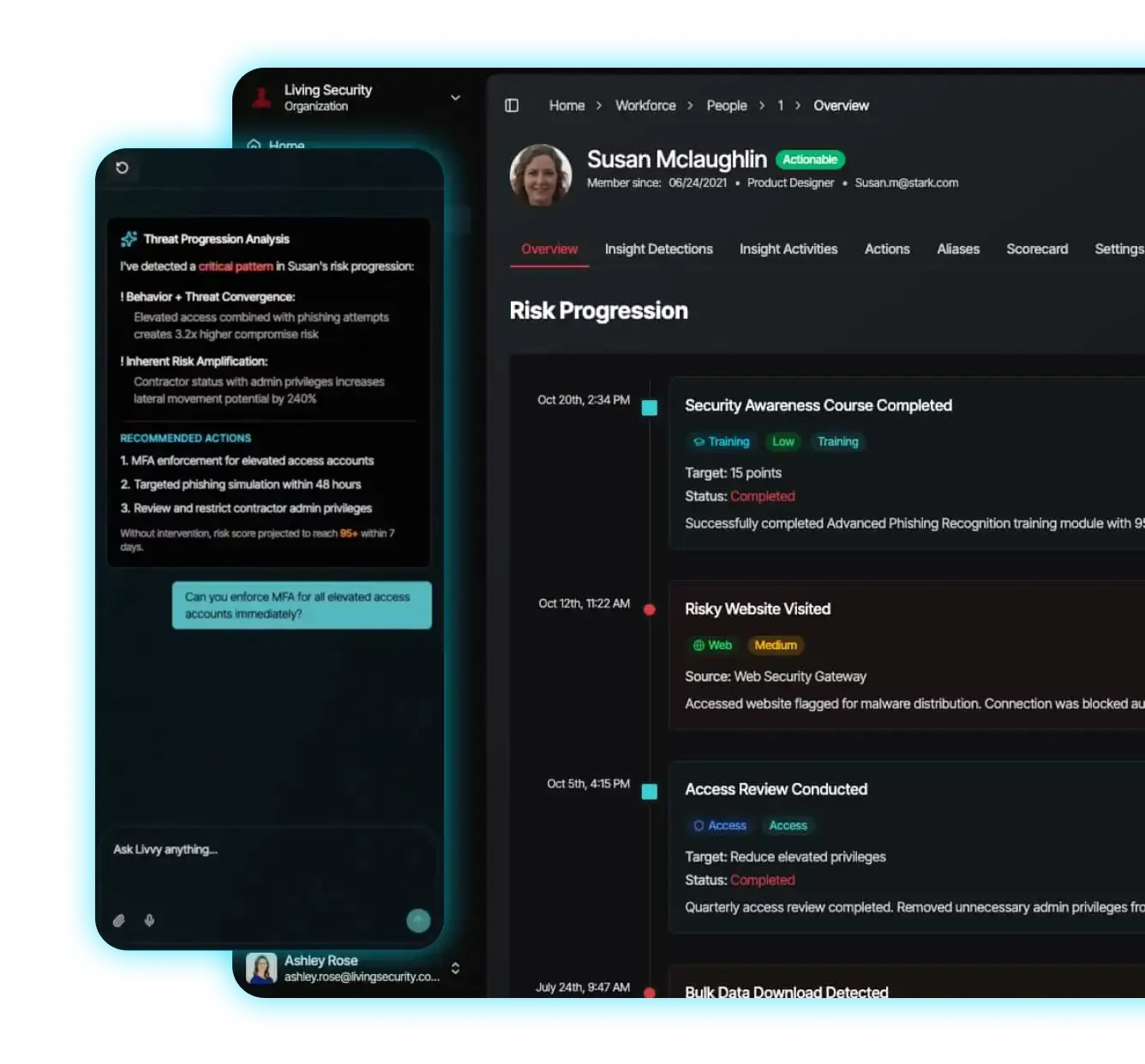
Your employees are already using generative AI, creating a new and often invisible attack surface. Every time they input a prompt or use AI-generated code, they can inadvertently expose sensitive data or introduce vulnerabilities. Securing AI isn't just about protecting the models; it's about managing the human element. Human Risk Management (HRM), as defined by Living Security, connects the dots between employee actions and AI agent risk. By understanding this relationship, you can implement targeted AI cybersecurity best practices that address the root cause of many incidents. This article will show you how to secure your organization by focusing on the people.
Key Takeaways
- Shift from reactive defense to proactive prevention: Traditional security tools are blind to AI-specific threats like data poisoning and prompt injection. A modern strategy must predict and neutralize risks in your models, data, and prompts before they can be exploited.
- Unify your view of risk by connecting disparate data: Your AI security posture is incomplete if it ignores the human element. Correlating signals across employee behavior, identity and access systems, and threat intelligence provides the comprehensive visibility needed to identify your most critical vulnerabilities.
- Scale your response with automated, human-led action: Manual remediation cannot keep pace with AI-driven threats. Implement a Human Risk Management (HRM) framework to autonomously address routine risks while keeping your security team in control, ensuring you can act on predictive insights instantly.
How Is AI Cybersecurity Different From Traditional Security?
While traditional cybersecurity focuses on protecting established infrastructure like networks, servers, and endpoints, AI security addresses a fundamentally different challenge. It’s about securing systems that learn, evolve, and make decisions. This shift introduces a new class of risks that legacy security tools and strategies were never designed to handle. Protecting AI involves safeguarding the models themselves, the data they are trained on, and the prompts that guide them.
The core difference lies in the attack surface. Traditional security looks for known vulnerabilities and malicious signatures in a relatively static environment. AI security, however, must contend with dynamic, complex systems where the vulnerabilities are often subtle and embedded in the logic of the model itself. This requires a new approach, one that moves beyond simple detection and response. A modern Human Risk Management (HRM) strategy is essential because it accounts for the complex interplay between people, processes, and these new intelligent technologies, giving you the visibility needed to protect against emerging threats.
Uncover AI Attack Surfaces Legacy Tools Miss
The adoption of AI creates new attack surfaces that are invisible to conventional security tools. Threats unique to AI, like feeding it malicious training data or using deceptive inputs to trick the model, don't trigger traditional alerts. For example, an attacker could subtly "poison" the data used to train a financial model, causing it to make disastrously incorrect predictions. Legacy firewalls and antivirus software have no way to detect this kind of manipulation. Protecting these new systems requires a platform built to understand and analyze the specific risks associated with AI, giving you a clear view of vulnerabilities that would otherwise go unnoticed.
Why Traditional Security Frameworks Fall Short
Traditional security frameworks often rely on predictable, rule-based systems. AI models, however, are probabilistic and incredibly complex, with countless decision points that are not always transparent. This inherent complexity makes them vulnerable to unique attack vectors that older security measures simply cannot address. AI introduces new kinds of threats, including data breaches from insecure models, attacks designed specifically for AI, and significant ethical concerns. As a result, standard cybersecurity playbooks are insufficient. Enterprises need specialized solutions and a dedicated security plan for AI that accounts for its dynamic and often unpredictable nature, ensuring that your defenses evolve as quickly as the technology itself.
What Are the Most Common AI Security Threats?
As organizations integrate AI into their operations, they also introduce a new class of security threats that target the entire AI lifecycle. Unlike traditional cyber threats that exploit software vulnerabilities, AI-specific attacks manipulate the logic, data, and infrastructure that power machine learning models. These threats can be subtle and difficult to detect with legacy security tools, creating blind spots that attackers are eager to exploit.
Understanding these common threats is the first step toward building a resilient AI security strategy. From corrupting the data that trains your models to tricking deployed systems into making catastrophic errors, each vulnerability requires a proactive and data-driven defense. Security teams must now account for risks in model training, deployment, and the complex third-party supply chains that support them.
Preventing Data Poisoning and Manipulation
Data poisoning is an attack where an adversary intentionally corrupts the data used to train an AI model. The objective is to compromise the model from the inside out, teaching it to produce incorrect or biased results once it's deployed. An attacker might subtly alter a dataset to create a specific backdoor, causing the model to misclassify certain inputs or respond to a hidden trigger. For example, a poisoned model might approve a fraudulent transaction if it contains a specific keyword.
This type of attack can be targeted, aiming for a precise failure, or untargeted, designed to simply degrade the model's overall performance and reliability. Because the malicious data is introduced during the training phase, its effects are deeply embedded in the model's logic. To defend against this, organizations need robust data governance and validation processes, continuously monitoring training data for anomalies and signs of intentional alteration.
Defending Against Adversarial Attacks
While data poisoning happens during training, adversarial attacks target AI models that are already deployed and operational. In this scenario, an attacker crafts malicious inputs, often with changes that are imperceptible to humans, to trick the model into making a mistake. A classic example is adding a small, carefully designed sticker to a stop sign that causes an autonomous vehicle's image recognition model to classify it as a speed limit sign.
These attacks exploit the gap between how machines perceive data and how humans do. They demonstrate that even highly accurate models can have surprising blind spots. Defending against them requires more than just static testing. It involves a strategy of continuous monitoring, model hardening, and adversarial training, where models are intentionally exposed to adversarial examples to make them more resilient against real-world manipulation attempts.
Protecting Against Model Theft and Extraction
Your AI models are valuable intellectual property. Model theft occurs when an attacker gains unauthorized access to and steals the model file itself. A more subtle threat is model extraction, where an adversary uses repeated queries to the model's API to reverse-engineer its architecture and parameters. By observing the outputs for a large number of inputs, they can effectively create a functional copy of your proprietary model.
Once an attacker has stolen or replicated your model, they can analyze it offline to discover vulnerabilities, develop more effective adversarial attacks, or simply steal your competitive advantage. Protecting against these threats requires strong access controls, rate limiting on APIs, and monitoring for unusual query patterns. Correlating identity, access, and behavioral data is critical to spotting the signals of a potential extraction attack in progress.
Securing Prompts from Injection and Jailbreaking
With the rise of Large Language Models (LLMs), prompt injection has become a significant threat. This attack involves embedding malicious instructions within a seemingly harmless prompt. The goal is to trick the LLM into ignoring its original programming and executing the attacker's commands, which could include revealing sensitive data, generating harmful content, or performing unauthorized actions on integrated systems. "Jailbreaking" is a similar technique used to bypass the model's built-in safety and ethics filters.
These vulnerabilities often arise from how employees interact with AI tools. Effective AI security awareness training is essential to teach users how to craft secure prompts and recognize potential injection attempts. Security teams must also implement input validation and output filtering to prevent malicious prompts from executing and sensitive information from leaking.
Managing Supply Chain and Third-Party AI Risks
Few organizations build their entire AI stack from scratch. Most rely on a complex supply chain of third-party components, including pre-trained models from open-source hubs, external datasets, and managed APIs. While this accelerates development, it also introduces significant risk. A vulnerability in any one of these external components can create a security hole in your own systems. For example, a popular open-source model could have been trained on poisoned data, or a third-party library could contain a critical flaw.
Managing this risk requires a proactive approach to supply chain security. Organizations must implement best practices like thoroughly vetting all third-party AI assets, demanding transparency from vendors, and maintaining a detailed inventory, or AI Bill of Materials (AI-BOM), for every model in production.
How Does Human Behavior Amplify AI Security Risks?
AI models and systems don't exist in a vacuum. They are built, trained, and used by people, which means human behavior is one of the most significant variables in your AI security posture. A simple mistake, a compromised credential, or a lack of awareness can create openings for attackers to exploit your AI investments. Understanding this connection is the first step toward building a resilient AI security strategy that accounts for the human element.
Connecting Human Risk to AI Agent Risk
Every time an employee uses a generative AI tool, they create a potential risk. Without proper guidance, they might input sensitive company data into a public model or use an AI-generated code snippet with hidden vulnerabilities. This is why effective AI security awareness training is crucial. It’s not just about teaching employees to spot AI-powered phishing attacks; it's about instilling safe habits for using AI tools responsibly. When you connect human risk signals to AI agent activity, you can see exactly how employee actions create security gaps, allowing you to intervene before a minor mistake becomes a major incident.
Why Identity and Access Are Critical Vulnerabilities
Your AI models are only as secure as the data they’re trained on. An attacker who gains access to your training datasets can intentionally corrupt them, an attack known as data poisoning. This can manipulate your model's behavior, leading to flawed outputs or biased decisions. The risk is amplified when employees have excessive access privileges. A single compromised account with high-level permissions can give an adversary the keys to your most critical AI systems. This makes managing identity and access a foundational piece of AI security, ensuring only the right people can influence your models.
How Behavior, Identity, and Threat Signals Expose Risk
To truly understand AI-related risks, you need to look beyond isolated behaviors. A comprehensive Human Risk Management (HRM) strategy correlates signals across three key pillars: employee behavior, identity and access systems, and real-time threat intelligence. For example, an employee might be using an unsanctioned AI tool (behavior), have access to sensitive financial data (identity), and be the target of a sophisticated phishing campaign (threat). Viewing these signals together provides a predictive view of risk, allowing you to act before an incident occurs. This data-driven approach helps you move from reactive defense to proactive risk reduction.
Secure Your AI Models and Systems: Key Best Practices
Securing your AI and machine learning models is not a one-time task; it is an ongoing process that requires a multi-layered defense strategy. As you integrate AI agents into your workflows, you must also implement technical controls to protect the models themselves and the systems they interact with. These practices are foundational for building a resilient AI security posture. They help protect your intellectual property, prevent model manipulation, and ensure the integrity of your AI-driven operations. By adopting these key best practices, you can build a secure foundation that mitigates risks across the entire AI lifecycle, from data ingestion to model deployment and monitoring. This proactive stance moves your security program from a reactive position to one that predicts and prevents incidents before they happen, which is the core of effective Human Risk Management (HRM).
Validate and Sanitize Model Inputs
A primary threat to AI systems is malicious input designed to manipulate model behavior. To counter this, you must operate under the assumption that all user-supplied data is potentially hostile. A critical first step is to validate and sanitize all inputs before they reach the model. This involves enforcing strict schemas to ensure data conforms to expected formats and using context isolation to prevent prompts from accessing or influencing other parts of the system. By treating input validation as a non-negotiable security gate, you can effectively defend against a wide range of prompt injection and data poisoning attacks that aim to compromise your model's integrity and security.
Apply Least-Privilege Access to AI Systems
Your AI models should only have access to the data and system functions essential for their designated tasks. Implementing the principle of least privilege is crucial for limiting the potential damage if a model is compromised. By applying a Zero Trust framework, you can ensure that the model cannot execute unauthorized commands, access sensitive databases, or interact with external tools without explicit permission. This approach significantly reduces the attack surface. If an attacker manages to manipulate the model, their ability to move laterally or exfiltrate data is severely restricted by these predefined access controls, containing the incident before it escalates.
Harden Models Against Adversarial Attacks
Adversarial attacks use carefully crafted, often imperceptible inputs to trick a model into making incorrect classifications or predictions. To defend against these sophisticated threats, you must actively harden your models. This process involves training the AI on datasets that include examples of adversarial inputs, which helps the model learn to recognize and resist them. Additionally, implementing preprocessing steps to clean, filter, and normalize inputs can strip away malicious manipulations before they are processed. Hardening is not a one-time fix but a continuous cycle of testing, training, and refinement to keep your models resilient against evolving adversarial techniques.
Adopt a Zero-Trust Architecture
A Zero Trust security model, which assumes no user or system is inherently trustworthy, is essential for securing modern AI ecosystems. Instead of relying on a protected internal network, a Zero Trust architecture enforces strict verification for every access request, regardless of its origin. This provides critical protection by tightly controlling access to sensitive AI training data, development environments, and deployment pipelines. By requiring continuous authentication and authorization for every interaction, you can prevent unauthorized access and lateral movement, safeguarding your valuable AI assets from both internal and external threats. This approach ensures that only verified entities can access specific AI resources.
Encrypt All Data in Transit and at Rest
The data that trains, validates, and runs your AI models is one of your most valuable assets and must be protected at all times. Implementing robust encryption is a fundamental security control. You must encrypt all data both at rest, when it is stored on servers or in databases, and in transit, as it moves across your network or the internet. This ensures that even if data is intercepted or a storage system is breached, the information remains unreadable and unusable to unauthorized parties. Furthermore, your data lifecycle management policies should enforce the secure and permanent disposal of training datasets and retired models to prevent future exposure.
Maintain an AI Bill of Materials (AI-BOM)
As your organization's use of AI grows, so does the complexity of your AI supply chain. To manage this complexity and its associated risks, it is essential to maintain an AI Bill of Materials (AI-BOM). An AI-BOM is a comprehensive inventory that documents all components of your AI systems, including the models you use (both proprietary and third-party), the datasets they were trained on, and the software libraries they depend on. This transparency is critical for tracking vulnerabilities, managing licenses, ensuring regulatory compliance, and quickly responding to security incidents within your AI supply chain. It provides the visibility needed to govern your AI ecosystem effectively.
Deploy an AI Gateway for Auditing and Authentication
An AI gateway acts as a centralized control plane for all interactions with your AI models, providing a critical chokepoint for security enforcement. By routing all requests through a gateway, you can consistently manage authentication and authorization, ensuring only legitimate users and systems can access your AI services. The gateway can also enforce rate-limiting to prevent denial-of-service attacks and log every request for comprehensive auditing and threat analysis. Deploying an AI gateway simplifies security management by consolidating these functions, giving you a single point of visibility and control over how your AI models are being used and by whom.
How to Secure the Data Fueling Your AI
Your AI models are only as reliable as the data they are trained on. If that data is flawed, biased, or malicious, your AI systems will inherit those weaknesses, creating significant security and operational risks. Securing the data that fuels your AI is not just a best practice; it is the foundation of a resilient AI security strategy. This involves protecting the integrity of your training datasets, safeguarding sensitive information, controlling who can access the data, and carefully vetting any external data sources or models you use.
A comprehensive approach requires you to think about the entire data lifecycle, from collection and storage to processing and use. By implementing robust controls at each stage, you can build trust in your AI outputs and defend against attacks designed to manipulate your models from the inside out. This proactive stance on data security allows you to prevent incidents before they happen, which is a core principle of effective Human Risk Management (HRM). It shifts your security posture from reactive to predictive, ensuring your AI initiatives are built on a secure and trustworthy foundation.
Protect Training Data Integrity
Data poisoning is an adversarial attack where an attacker intentionally corrupts the training data used to build an AI model. The objective is to secretly influence the model's behavior so it makes incorrect predictions or classifications once deployed. For example, an attacker could subtly alter images in a dataset to make a model misidentify threats or approve fraudulent transactions.
This type of manipulation is difficult to detect because the changes can be minor and spread across vast datasets. As experts at Palo Alto Networks explain, the goal is to "influence the model's behavior during training in a way that persists into deployment." To protect data integrity, you must secure your entire data pipeline, implementing version control for datasets, using checksums to detect unauthorized modifications, and restricting write access to training data repositories.
Anonymize and Minimize Sensitive Data
Not all data is necessary for training an effective AI model. The principle of data minimization dictates that you should only collect and use the data that is absolutely essential for your model’s purpose. By limiting the data you hold, you reduce your attack surface and minimize the potential impact of a data breach. Before feeding data into a model, you should also anonymize or pseudonymize it to remove personally identifiable information (PII) and other sensitive details.
This process is critical for both security and compliance with regulations like GDPR and CCPA. As noted by Lasso Security, compromised data can make models "less trustworthy, or even outright harmful." Anonymizing data helps protect individual privacy and reduces the risk of your AI models inadvertently leaking sensitive information through their outputs.
Govern Data Access with Strict Controls
To protect your data, you must control who can access it. Implementing strict access controls based on the principle of least privilege ensures that employees and systems only have access to the data they absolutely need to perform their functions. Use role-based access control (RBAC) to define granular permissions for data scientists, engineers, and other team members involved in the AI development lifecycle.
However, static controls are not enough. As Obsidian Security points out, detection requires "continuous monitoring of model behavior, data integrity validation, and anomaly detection." By correlating identity and access data with behavioral signals and threat intelligence, you can spot risky access patterns or unauthorized activity that could indicate an insider threat or a compromised account. This is a central function of the Living Security Platform, the leading Human Risk Management Platform.
Audit External Models and Data Sources
Few organizations build their AI systems entirely from scratch. Most rely on a combination of third-party datasets, pre-trained models, and open-source libraries. While this accelerates development, it also introduces supply chain risks. You must treat external AI components with the same level of scrutiny as any other third-party software.
Before integrating an external model or dataset, conduct thorough due diligence on the provider. As the team at Wiz advises, you should "carefully check any outside AI tools or companies you use" to ensure they meet your security standards for data protection and access control. Maintaining an AI Bill of Materials (AI-BOM) to track all the components in your AI systems helps you quickly identify and respond to vulnerabilities discovered in third-party code or data.
How to Continuously Monitor and Test Your AI Security
Deploying AI is not a finish line; it’s the starting point for a continuous cycle of monitoring, testing, and refinement. AI models are dynamic, learning from new data and interacting with complex environments, which means their risk profile is constantly changing. A static, "set-it-and-forget-it" security posture is insufficient. Instead, enterprises need a proactive and adaptive strategy to stay ahead of emerging threats. This involves rigorously testing your systems for weaknesses, analyzing their behavior in real time for anomalies, integrating security checks directly into your development lifecycle, and empowering your security team with intelligent tools that maintain human oversight. By adopting a continuous validation approach, you can ensure your AI systems remain secure, trustworthy, and resilient against sophisticated attacks.
Conduct Red-Teaming and Adversarial Testing
To secure your AI, you need to think like an attacker. This is the core principle behind AI red-teaming, a form of ethical hacking where security teams proactively search for vulnerabilities in AI systems. As recommended by CISA, this type of adversarial testing is essential for discovering how models react to unexpected or malicious inputs designed to cause failure. By simulating real-world attacks, your team can identify and patch weaknesses before they are exploited. This process should be continuous, not a one-time event, allowing you to test your defenses against new attack techniques as they emerge. Red-teaming provides critical insights into your model's resilience and helps you build more robust, secure, and trustworthy AI applications for your enterprise.
Use Anomaly Detection for Real-Time Analysis
Continuous monitoring is the bedrock of proactive AI security. Your models and the data they process must be analyzed in real time to detect deviations from normal behavior that could signal an attack. Implementing anomaly detection allows you to identify subtle indicators of threats like AI data poisoning or model evasion. This requires constant validation of data integrity and model outputs throughout the AI lifecycle. At Living Security, our leading Human Risk Management platform correlates signals across employee behavior, identity systems, and threat intelligence to predict risk. Applying a similar, data-driven approach to AI security enables you to spot suspicious patterns early, investigate potential incidents faster, and act decisively to protect your systems before significant damage occurs.
Automate Security Testing in Your CI/CD Pipeline
Security should be an integral part of your AI development process, not an afterthought. By embedding automated security testing directly into your continuous integration and continuous delivery (CI/CD) pipeline, you can identify and remediate vulnerabilities early in the development lifecycle. This "shift-left" approach involves using specialized tools to regularly scan AI models and applications for common weaknesses, such as misconfigurations, data leakage, or inherent biases. According to AI security best practices, testing early and often is key to preventing minor issues from escalating into major threats. Automating these checks makes security a seamless and efficient part of your workflow, enabling your teams to innovate quickly without compromising on safety and compliance.
AI with Human Oversight: Keep Your Security Team in Control
Automation is a powerful force multiplier, but it cannot replace the critical judgment of your security experts. The most effective AI security strategy combines autonomous systems with human-in-the-loop oversight. This approach allows you to automate routine tasks while ensuring your team remains in control of key decisions. The Living Security platform embodies this principle with Livvy, an AI guide that provides explainable, evidence-based recommendations to security teams. This empowers them to understand risk trajectories and act with confidence. As experts note, combining autonomous threat detection with AI security awareness creates a powerful defense-in-depth strategy. This ensures your team is equipped to manage both technological and human-driven risks, keeping them firmly in command.
How to Build an Effective AI Security Awareness Program
As AI becomes integrated into daily workflows, your employees become a primary vector for new, sophisticated threats. An effective AI security awareness program is not just an extension of your existing training; it requires a fundamental shift in strategy. The goal is to build a resilient workforce that can recognize and respond to AI-specific risks, from deepfake phishing attempts to the mishandling of sensitive data with generative AI tools.
Living Security, a leader in Human Risk Management (HRM), helps organizations move beyond compliance-based training to a predictive model. An effective program starts by making AI-related human risk visible and measurable. By correlating data across employee behavior, identity systems, and threat intelligence, you can deliver targeted actions that genuinely change behavior and secure your organization against emerging AI threats.
Why One-Size-Fits-All Training Fails
Annual, generic security training was never the most effective approach, and it’s completely inadequate for addressing AI-driven risks. The threats are too diverse, nuanced, and fast-evolving for a single training module to cover. A developer using a code generation tool faces entirely different risks than a marketing team member using an AI content creator or an executive targeted by a deepfake voice call.
One-size-fits-all training fails because it ignores context, which is the most critical element in human risk. A blanket policy on AI usage won't prevent a well-meaning employee from pasting proprietary code into a public AI model. To be effective, security awareness training must evolve to address the specific AI tools, access levels, and behaviors relevant to each person’s role.
Tailor Training to Roles, Risks, and Access Levels
The first step in designing an effective program is to identify the specific AI security risks your organization faces. A targeted risk assessment helps you understand how different teams use AI and where the greatest vulnerabilities lie. This allows you to move from generic warnings to specific, actionable guidance that resonates with employees’ daily tasks. For example, your finance team needs training on spotting AI-generated invoice fraud, while your R&D team needs guidance on protecting intellectual property when using research tools.
A truly effective Human Risk Management program goes even deeper. By analyzing risk signals across behavior, identity, and threat data, you can tailor interventions not just to a role, but to an individual. An employee with elevated system access who also shows a pattern of clicking on suspicious links requires a different, more immediate intervention than a colleague with less access.
Use Adaptive Micro-Training and Phishing Simulations
Long training sessions are quickly forgotten. The most effective learning happens in short, relevant bursts delivered at the moment of need. Adaptive micro-training provides exactly that: brief, focused educational content triggered by a specific risky action. If an employee attempts to use an unsanctioned AI tool, the system can immediately deliver a two-minute video or a quick tip explaining the associated risks and pointing them to a company-approved alternative.
This approach also applies to phishing simulations. Instead of just sending generic fake emails, you can simulate sophisticated, AI-generated spear-phishing attacks that are personalized and highly convincing. These realistic simulations train employees to spot the subtle cues of advanced threats, building resilience through practice in a safe environment.
Measure Effectiveness with Behavioral and Threat Signals
How do you know if your AI security awareness program is working? Completion rates and quiz scores won't tell you. The only true measure of success is a quantifiable reduction in risky behavior. An effective program is built on a data-driven foundation that provides clear visibility into whether your interventions are actually changing how employees act. This means tracking metrics that matter, like reductions in clicks on phishing links, safer data handling practices, and proper use of approved AI tools.
By correlating data from multiple sources, including employee actions, identity and access management systems, and real-time threat feeds, you can get a complete picture of your organization's risk posture. This allows you to demonstrate measurable improvement and report on outcomes, not just activities. The latest human risk data shows that this integrated approach is critical for predicting and preventing incidents.
Keep Training Content Current with Evolving AI Threats
The AI threat landscape is constantly changing. New attack methods, vulnerabilities in AI models, and more sophisticated social engineering tactics emerge continuously. A "set it and forget it" training program will be obsolete within months. Your security awareness content must be as dynamic as the threats it’s designed to combat. This means having a process to stay updated on the latest AI security risks and regularly refreshing your training materials and risk assessments.
Keeping content current is a significant challenge for any security team. This is where an AI-native Human Risk Management platform becomes a critical partner. The platform continuously analyzes emerging threat intelligence to update training modules, phishing simulations, and risk models. This ensures your awareness program remains relevant and effective, preparing your employees for the threats of tomorrow, not just the threats of yesterday.
What Compliance Frameworks Apply to AI Security?
As organizations integrate AI into their operations, a new and evolving landscape of compliance frameworks is taking shape. Navigating these regulations is not just a task for the legal department; it is a core function of modern cybersecurity. Frameworks are emerging globally to ensure that AI systems are developed and deployed responsibly, with a strong focus on transparency, fairness, accountability, and privacy. For security leaders, this means that proving compliance is now inseparable from proving security.
Meeting these new standards requires more than just technical controls. It demands a deep understanding of how both people and AI agents interact with sensitive data and critical systems. Traditional security approaches often fail to capture this dynamic, leaving dangerous gaps in visibility. An effective Human Risk Management (HRM) program provides the data-driven foundation necessary to make these interconnected risks visible, measurable, and actionable. By correlating signals across user behavior, identity systems, and threat intelligence, you can build a security strategy that not only satisfies auditors but also proactively prevents incidents in the complex world of AI.
Key Regulations Shaping AI Security
Several key regulations are setting the global standard for AI governance. The EU AI Act establishes a risk-based approach, imposing stricter rules on high-risk AI systems while allowing for more flexibility with lower-risk applications. In the United States, the NIST AI Risk Management Framework provides voluntary guidance for organizations to better manage the risks associated with AI. While their legal authority differs, both frameworks champion the development of trustworthy and safe AI. They emphasize the need for robust data governance, continuous monitoring, and clear human oversight. For enterprise organizations, aligning with these frameworks is essential for maintaining market access, building customer trust, and establishing a defensible security posture.
Map AI Risk to Your GRC Obligations
For Governance, Risk, and Compliance (GRC) teams, the introduction of AI requires extending existing frameworks to cover new, specific risks. This process begins with mapping AI-related threats, such as data poisoning or prompt injection, to your organization's unique GRC obligations. You must be able to demonstrate how your controls mitigate these specific threats. This is impossible without clear visibility into risk signals across your entire digital and human ecosystem. A comprehensive view that correlates employee behavior, identity and access data, and real-time threats allows you to quantify AI-related human risk and report on it effectively. This data-driven approach transforms compliance from a reactive, checklist-based exercise into a proactive, risk-reducing strategy.
Maintain Transparent, Fair, and Audit-Ready Documentation
Proving compliance with AI regulations depends on maintaining meticulous, audit-ready documentation. Regulators and auditors will expect clear records demonstrating how your AI systems function, what data they use, and how you test for and mitigate bias. This documentation should be a living repository, updated continuously as models evolve and new data is introduced. Frameworks like the OWASP AI Security and Privacy Guide offer practical advice for creating the necessary documentation to protect AI systems. Maintaining this level of transparency is not just for auditors; it is fundamental to building trust with customers and internal stakeholders. It shows that your organization is committed to using AI responsibly and ethically, which is a powerful competitive differentiator.
Build an AI Cybersecurity Strategy That Scales
Building a security strategy that can keep pace with the rapid evolution of AI requires a fundamental shift in thinking. Legacy tools and reactive postures are no longer sufficient to address the new attack surfaces and threat vectors introduced by AI. A scalable and effective AI cybersecurity strategy is built on a proactive, data-driven foundation. It moves beyond simply monitoring systems to understanding the complex interplay between humans, AI agents, and the data they access. This means creating a unified view of risk that connects disparate signals from across your security stack.
A modern strategy extends your security perimeter to include non-human actors and leverages automation to act at machine speed. Most importantly, it involves shifting your entire security program from a reactive "detect and respond" model to a predictive one. By focusing on prevention, you can address vulnerabilities before they become incidents, saving your team time and reducing organizational risk. The following practices are essential for building a resilient strategy that protects your organization as you integrate AI into your operations.
Correlate Behavior, Identity, and Threat Data
A siloed view of risk is a blind spot. To accurately understand your AI security posture, you must correlate data across multiple dimensions. A scalable strategy integrates signals from user behavior, identity and access systems, and real-time threat intelligence. Analyzing these datasets together reveals risk trajectories that are invisible when viewed in isolation. For example, you can identify a user who exhibits risky behavior, has privileged access to critical systems, and is being targeted by a phishing campaign. This multi-faceted view allows you to prioritize the most critical risks and apply targeted interventions where they will have the greatest impact. This is the core of a data-driven Human Risk Management program.
Extend Visibility to AI Agents and Non-Human Actors
Your security strategy is incomplete if it only focuses on human users. As AI agents and other non-human actors become more prevalent in enterprise environments, they introduce a new attack surface. These agents can access, process, and create data, making them a potential vector for security breaches. An effective AI security strategy must extend visibility to monitor the behavior of these autonomous systems. By tracking their interactions and data access patterns, you can detect anomalies that may indicate a compromise or misuse. Treating AI agents as part of your overall risk landscape is critical for maintaining security in a hybrid human-machine workforce.
Remediate Risks Autonomously with Human Oversight
The speed and volume of AI-driven activities mean that manual remediation is no longer viable. To scale your response capabilities, you must leverage automation. An AI-native security platform can autonomously execute routine remediation tasks, such as delivering adaptive micro-training, sending security nudges, or enforcing policies when a risk is identified. This allows your security team to act instantly and at scale. However, automation should not mean a loss of control. The most effective approach is "AI with human oversight," where the security team remains in the loop, setting policies and reviewing actions. This model combines the speed of machines with the critical judgment of your human experts.
Shift from Reactive to Predictive with Human Risk Management (HRM)
Traditional cybersecurity is often a reactive exercise, focused on responding to alerts and cleaning up after an incident. A truly scalable strategy shifts this paradigm from reactive to predictive. By implementing Human Risk Management (HRM), you can use data to anticipate where your next security incident is likely to originate. The Living Security Platform analyzes hundreds of signals to predict risk across both human and AI actors, allowing you to proactively intervene before a threat materializes. This forward-looking approach enables you to move beyond endless cycles of detection and response and build a more resilient, preventative security posture that scales with your organization.
Frequently Asked Questions
How is securing AI different from the cybersecurity I'm used to?
The main difference is that you are no longer just protecting static infrastructure like servers and networks. You are now securing dynamic systems that learn and make decisions. Traditional security looks for known vulnerabilities in predictable environments, while AI security must defend against attacks that manipulate a model's logic, its training data, or the prompts that guide it. This requires a new strategy focused on the entire AI lifecycle, not just the perimeter.
My employees are using public AI tools. What's the real risk?
The immediate risks are data leakage and insecure code. When employees input sensitive company information or proprietary data into public AI models, that information can become part of the model's training data, potentially exposing it. Similarly, using AI-generated code without proper vetting can introduce hidden vulnerabilities into your applications. These actions create a direct link between everyday human behavior and significant organizational risk, which is why visibility into how employees use these tools is so critical.
What's the first practical step my team should take to secure our AI models?
A great starting point is to focus on data and access. Begin by implementing strict access controls for your AI systems and the data they use, applying the principle of least privilege. This ensures models and the people who manage them only have access to what is absolutely necessary for their function. Securing your training data from unauthorized modification is another foundational step that protects the integrity of your models from the very beginning.
How does Human Risk Management (HRM) provide a better way to manage AI security risks?
Human Risk Management (HRM), as defined by Living Security, offers a more complete picture of your risk landscape. Instead of looking at technical vulnerabilities in isolation, it correlates data across three key pillars: employee behavior, identity and access systems, and real-time threat intelligence. This unified view allows you to see how human actions and AI agent activity create risk trajectories. It helps you move from a reactive posture to a predictive one, so you can act before a potential issue becomes a full-blown incident.
With new AI regulations emerging, how can I ensure my organization stays compliant?
Emerging frameworks like the EU AI Act and the NIST AI Risk Management Framework emphasize transparency, accountability, and fairness. The most effective way to meet these requirements is to build your AI security program on a data-driven foundation that makes risk visible and measurable. An HRM platform provides the audit-ready documentation and continuous monitoring needed to demonstrate that you are managing AI responsibly, satisfying auditors while also genuinely reducing risk.