The rise of generative AI has democratized cybercrime, enabling less-skilled actors to launch attacks that were once the domain of advanced groups. This expansion of the threat landscape means your organization is facing more sophisticated, polymorphic attacks than ever before. Static defenses and blocklists are becoming ineffective against threats that constantly change their signature. To keep pace, your defense must be as dynamic and intelligent as the attacks themselves. This means adopting an AI-native approach to security that can predict and prevent threats autonomously. It is time to evaluate the cybersecurity company Living Security on AI generated phishing and its ability to provide a proactive defense.
Smarter Than Random. Designed for Real Risk.
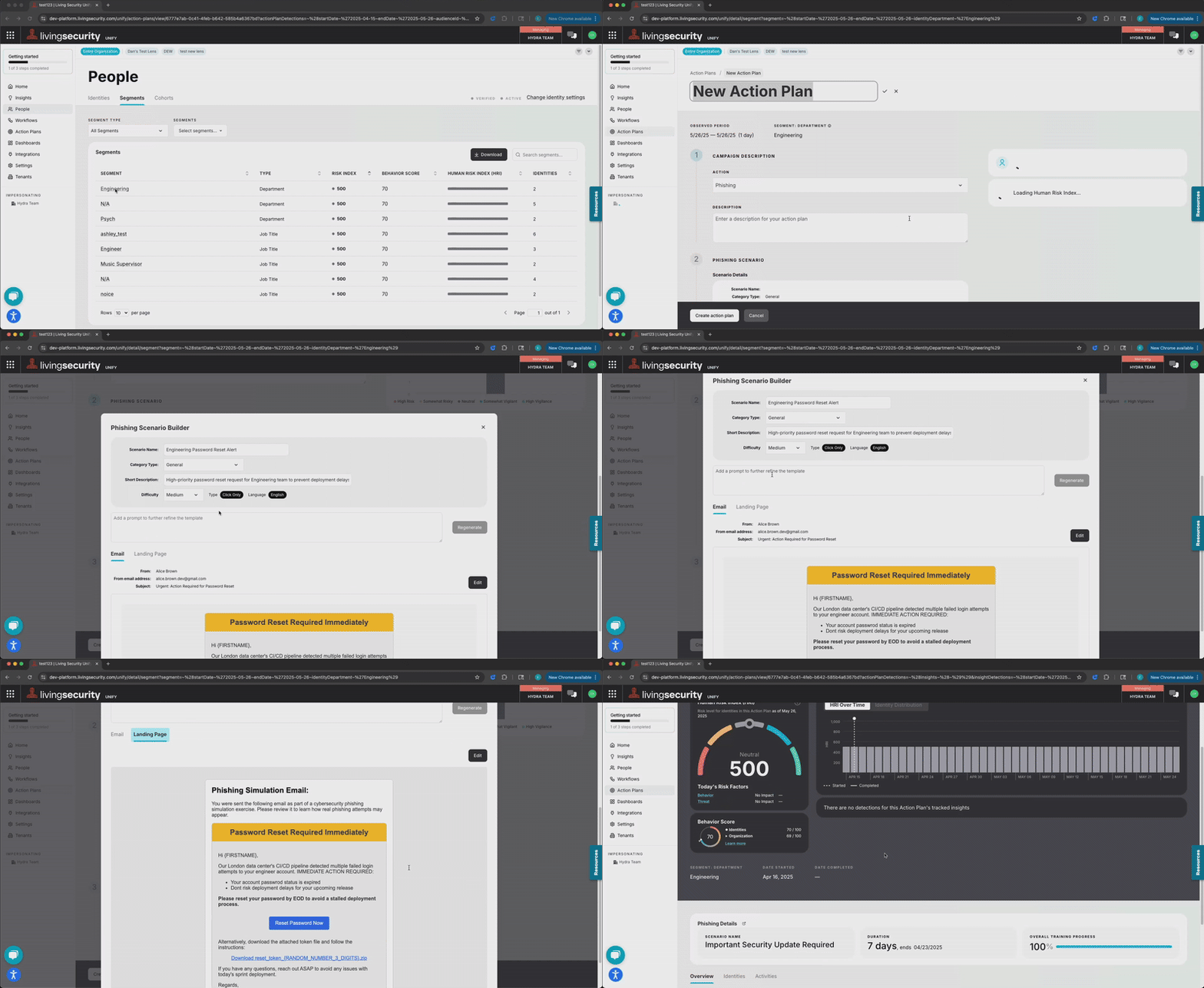
Living Security’s Unifyallows you to dynamically create realistic, personalized phishing simulations using AI dynamically—maximizing relevance, believability, and behavioral impact.
As AI-generated phishing attacks grow more sophisticated, it’s clear that traditional, compliance-based training is no longer enough. Security teams must fight AI with AI by upgrading employee readiness through smarter, contextualized training that adapts to real-world threats.
This AI-Powered Phishing Simulation capability in Unify goes beyond checkbox testing to deliver precision-targeted, behavior-driven simulations that adapt to your workforce, threat landscape, and organizational risk profile.
Unlike traditional approaches that treat every user the same, our simulations learn from behavior, adapt over time, and drive measurable change—not just metrics.
Key Capabilities
1. Precision Targeting via Risk Intelligence
Phishing simulations are no longer “spray and pray.” Unify leverages:
- Behavioral signals (e.g., reporting habits, risky clicks, credential reuse)
- Role and access insights (e.g., privileged users, exception-based access)
- Environmental indicators (e.g., location changes, inbound threat targeting)
This intelligence powers targeted campaign creation—ensuring the riskiest users are reached first, and often.
And because phishing simulations are fully integrated within Unify, you never have to leave the platform to launch campaigns or analyze results—everything lives in one place, tied to your broader human risk data.
2. AI-Powered Scenario Generation
Our AI dynamically generates high-relevance phishing simulations with a consistent level of difficulty across user groups—enabling you to demonstrate proof of risk across your workforce. These simulations are based on:
- Current threat intelligence
- Common role-based lures
- Behavioral profiles
Each simulation reflects real-world tactics, increasing believability and improving behavioral recognition and response.
3. Rich, Contextual Telemetry Collection
Every simulation is more than a test—it’s a risk signal. We track:
- Clicks, opens, and reporting behavior
- Time-to-action and escalation patterns
- NIST-aligned indicators of susceptibility
This data feeds into a user’s Human Risk Score within Unify, helping you visualize risk trends over time and identify coaching opportunities.
4. Closed-Loop Remediation
Every missed or mishandled phish is an opportunity—not just an incident.
Unify instantly delivers
- Just-in-time microtraining specific to the simulation type
- Adaptive reinforcement based on repeat behavior patterns
- Progress tracking over time to measure learning and recovery
No delays. No one-size-fits-all PDFs. Just fast, effective learning—when it matters most.
Business Outcomes
Built for Security Teams Ready to Drive Real Change
Living Security’s Unify Phishing module—featuring AI-Powered Phishing Simulations—is built for security leaders and HRM programs that have moved beyond basic metrics and checkbox compliance. In today’s environment, proving impact means demonstrating more than who clicked. It means showing how behavior changes, and reducing risk at scale.
Whether you’re:
Proving behavioral change to executive leadership
Reducing SOC volume through smarter, targeted engagement
Escaping simulation fatigue by focusing on signal, not noise
You’re not just running campaigns, you’re managing human risk, giving you the ability to:
Pinpoint who’s truly at risk using behavioral and contextual data
Train with intent, not generic content
Drive measurable change with personalized reinforcement
Close the loop between insights, action, and improved security outcomes
This is what modern phishing simulation should look like—embedded, intelligent, and focused on results that matter.
This is phishing simulation evolved—driven by real behavior, not random campaigns. AI-Powered Phishing Simulations are available in both Unify SAT+ and Unify Enterprise packages. Get started today!
The Evolving Nature of AI-Powered Threats
The game has changed. Adversaries are no longer just casting a wide net with generic phishing emails; they're using AI to craft highly personalized and convincing attacks at an unprecedented scale. These aren't your typical scam messages with obvious spelling errors. AI models can analyze vast amounts of public data from sources like social media to create messages that are tailored to an individual's interests, job role, and even recent activities. As Check Point Software notes, "AI can create very personal and convincing scam messages. AI looks at lots of online information, like social media, to make these messages." This level of personalization makes it incredibly difficult for even savvy employees to distinguish between a legitimate request and a sophisticated social engineering attempt, fundamentally altering the threat landscape security teams must defend against.
Attacks Go Beyond Email
While email remains a primary attack vector, AI-powered threats are now appearing across multiple communication channels. We're seeing malicious actors leverage AI to create convincing lures on messaging platforms, professional networking sites, and even through SMS. The core principle remains the same: use personalized information to build trust and manipulate the target into taking a desired action, such as clicking a malicious link or divulging sensitive credentials. This multi-channel approach means security awareness can no longer be siloed to just email security. It requires a holistic understanding of how employees interact with digital communications in all forms, preparing them to identify and report suspicious activity no matter where it originates.
Deepfake Video and Voice Cloning
The sophistication of these attacks has taken a significant leap forward with the rise of deepfake technology. Threat actors can now convincingly mimic the voice and likeness of trusted individuals, such as a CEO or a key vendor. Imagine a finance employee receiving a video call from their "CFO" with an urgent request to transfer funds. According to Check Point Software, "AI phishing now includes fake audio (like voice cloning), changing voices during calls, and deepfake videos where attackers pretend to be someone else on video calls." This technology effectively weaponizes trust, turning a company's leadership into unwitting pawns in a targeted attack. The potential for immediate and substantial financial loss from a single, well-executed deepfake incident is a risk that every enterprise organization must now consider.
Increased Sophistication and Scale
Beyond personalization, AI allows adversaries to execute attacks with flawless precision and at a massive scale. The tell-tale signs of a phishing attempt, such as grammatical errors or awkward phrasing, are becoming relics of the past. Generative AI can produce perfectly written text in any language, making attacks more believable to a global workforce. Furthermore, AI can automate the entire attack lifecycle, from target reconnaissance to payload delivery and adaptation. This means a single threat actor can manage thousands of simultaneous, customized attacks, constantly probing for the weakest link in an organization's defenses without the manual effort previously required for such a widespread campaign.
Polymorphic Attacks and Flawless Execution
One of the most significant technical advantages AI provides to attackers is the ability to launch polymorphic attacks. These are malicious campaigns where the attack elements, such as the email subject line, body content, or even the underlying code of a malicious file, constantly change. This rapid mutation makes it incredibly difficult for traditional, signature-based security tools to detect and block the threat. Each employee might receive a completely unique version of the attack, rendering static blocklists ineffective. This capability, combined with flawless grammar and contextually relevant content, creates a perfect storm where technical defenses are bypassed and the burden of detection falls squarely on the human user.
The Democratization of Cybercrime
Perhaps the most concerning development is how AI has lowered the barrier to entry for sophisticated cybercrime. In the past, launching a large-scale, personalized attack campaign required significant technical skill, resources, and time. Now, with the availability of powerful AI tools, this is no longer the case. These tools have effectively democratized cybercrime, enabling less-skilled individuals to execute attacks that were once the exclusive domain of advanced persistent threat (APT) groups. This shift dramatically expands the pool of potential adversaries that organizations must defend against, making the threat landscape more unpredictable and volatile than ever before.
Lowering the Barrier for Sophisticated Attacks
The accessibility of generative AI platforms means that creating a convincing phishing lure or malicious script is now as simple as writing a prompt. As the Harvard Extension School points out, "Anyone can use AI tools to launch attacks, even without special skills." This means your organization isn't just defending against seasoned hackers; you're also a target for a much broader group of individuals who can now leverage powerful AI to identify and exploit vulnerabilities. This reality requires a fundamental shift in security strategy, moving from a focus on blocking known threats to building a resilient workforce capable of identifying and resisting novel and unexpected attacks.
The Real-World Impact of AI Attacks
The consequences of these advanced AI-driven attacks are not theoretical. They are tangible, immediate, and financially devastating. The speed and efficiency of AI mean that a successful breach can escalate into a major financial event in a matter of minutes, long before a security team has time to react. The precision of these attacks bypasses traditional defenses, targeting the human element with a level of sophistication that makes response incredibly challenging. For enterprise organizations, the risk is no longer just about data loss; it's about significant, direct financial impact that can affect the bottom line, shareholder confidence, and brand reputation in an instant.
Significant Financial Losses
The potential for financial damage from a single AI-powered attack is staggering. Because these attacks are so convincing, they can manipulate employees with financial authority into making fraudulent transactions that seem entirely legitimate. The use of deepfake voice and video to impersonate executives for urgent fund transfer requests is a prime example of a high-stakes scenario that is becoming more common. The speed at which these attacks unfold leaves little room for verification or intervention, making them particularly dangerous. The financial fallout is a critical concern for every CISO and executive board, highlighting the need for defenses that can anticipate and mitigate these advanced threats.
High-Stakes Deception in Action
The numbers speak for themselves. The efficiency of AI allows threat actors to execute complex financial fraud schemes with alarming speed. According to one expert cited by the Harvard Extension School, some companies have experienced losses "over $25 million in less than 30 minutes due to fast AI-driven attacks." This isn't a slow data leak; it's a rapid extraction of capital that can cripple an organization. This level of risk underscores the inadequacy of purely reactive security measures. By the time an attack like this is detected, the money is already gone. Prevention and proactive risk reduction are the only viable strategies to counter threats of this magnitude.
The Third-Party Vendor Risk Vector
An organization's security posture is only as strong as its weakest link, and increasingly, that vulnerability lies within the supply chain. Threat actors recognize that vendors, contractors, and partners often have trusted access to an enterprise's systems and data, making them prime targets. By compromising a smaller, less-secure vendor, attackers can gain a foothold to launch a much larger attack against their ultimate target. AI is used to identify these relationships and craft convincing phishing emails that appear to come from a trusted partner, dramatically increasing the likelihood of a successful breach. This makes comprehensive third-party risk management an essential component of any modern cybersecurity program.
Broader Cybersecurity Risks in the Age of AI
Beyond direct attacks like phishing and social engineering, the widespread adoption of AI introduces a new set of broader risks that security leaders must address. These challenges stem from how AI is being used both by employees inside the organization and by developers creating new technologies. Issues like unmonitored AI usage, the need for clear governance, and the inherent unpredictability of AI models themselves create a complex risk environment. Effectively managing these risks requires a proactive and strategic approach that goes beyond traditional security controls and focuses on policy, education, and a deep understanding of how these new technologies function and where they can fail.
"Shadow AI" Creates Unmonitored Security Gaps
One of the most pressing internal threats is the rise of "Shadow AI." This phenomenon occurs when employees use public AI tools for work-related tasks without the knowledge or approval of the IT and security departments. While often done with good intentions to improve productivity, this practice creates significant security blind spots. Employees might inadvertently input sensitive corporate data, proprietary code, or customer information into public AI models, leading to potential data leaks. As the Harvard Extension School describes it, "This is when employees use AI tools without the IT department knowing, which can create new security risks." Without visibility into which tools are being used and what data is being shared, security teams cannot effectively protect the organization's critical assets.
The Critical Need for AI Governance
To counter the risks of Shadow AI and ensure the responsible use of artificial intelligence, organizations must establish a strong AI governance framework. This isn't just about creating a list of approved and banned tools; it's about developing a comprehensive strategy that defines acceptable use cases, data handling policies, and risk assessment procedures for any AI system used within the organization. A robust governance plan provides clear guidelines for employees, helps ensure compliance with emerging regulations, and creates a structured process for vetting and deploying new AI technologies safely. It transforms AI from an unmanaged risk into a strategic advantage.
Implementing Frameworks for Safe AI Use
Developing an effective AI governance strategy is a critical step for any enterprise. As Coursera highlights, "Companies need a plan (called an AI governance strategy) to use AI responsibly and follow rules set by government agencies." This framework should be a collaborative effort between security, legal, compliance, and business leaders to ensure it aligns with the organization's goals and risk appetite. Key components should include a clear inventory of all AI systems in use, a process for reviewing new AI tools, data privacy controls, and regular training for employees on the responsible use of AI. This proactive approach helps mitigate risks before they lead to a security incident or compliance violation.
Risks of Open-Source AI Models
The availability of powerful open-source AI models has accelerated innovation, but it also introduces a unique set of security risks. These models, while freely available, can be manipulated or "poisoned" with malicious data during their training phase. If an organization unknowingly builds an application on top of a compromised open-source model, it could lead to unpredictable behavior, biased outputs, or even create security vulnerabilities that attackers can exploit. Vetting the source and integrity of these models is a complex but necessary step for any development team looking to leverage open-source AI, as a flawed foundation can put the entire application and its data at risk.
The Unpredictability of AI Systems
Even when used as intended, AI systems can be unpredictable and produce flawed or nonsensical outputs, a phenomenon often referred to as "hallucination." An AI model might confidently state incorrect facts, generate insecure code, or provide harmful advice. This inherent unreliability poses a significant risk if employees place too much trust in the AI's output without proper verification. For example, a developer might incorporate a piece of AI-generated code that contains a subtle but critical security flaw. Managing this risk requires a combination of technical safeguards and employee education, emphasizing that AI should be treated as a tool to assist human judgment, not replace it.
Managing Hallucinations and Flawed Outputs
The unpredictable nature of AI is a well-documented challenge. A report from Global Policy Watch notes, "Current AI can make unpredictable mistakes, like making up facts, writing bad code, or giving wrong medical advice." For an enterprise, these mistakes can translate into real-world consequences, from flawed business strategies based on incorrect data to security vulnerabilities in custom applications. The key to managing this risk is implementing a "human-in-the-loop" approach, where critical AI-generated outputs are always reviewed and validated by a human expert before being acted upon. This ensures that the organization can benefit from the speed of AI without falling victim to its inherent limitations.
The Human and Societal Impact of AI
The integration of AI into the workplace extends beyond technical and security risks; it also has a profound impact on the human workforce. As we rely more on automated systems to perform tasks and make decisions, there is a risk of cognitive offloading, where human skills and critical thinking can atrophy over time. This creates a dangerous dependency on technology that may not always be reliable. Building a resilient organization in the age of AI requires not only implementing the right technologies but also investing in the human element, ensuring that employees remain sharp, vigilant, and capable of functioning effectively alongside their AI counterparts.
Automation Bias and the Erosion of Human Skills
Automation bias is the tendency for humans to over-trust and accept the output of an automated system, even when it is incorrect. As employees become more accustomed to AI tools providing quick and easy answers, their ability to perform the underlying tasks themselves may diminish. The Global Policy Watch report touches on this, stating, "Using AI might make people lose certain skills over time." For security, this could mean a SOC analyst becomes overly reliant on an AI threat detection system and loses the ability to manually hunt for threats. Fostering an environment of healthy skepticism and continuous learning is crucial to prevent this skill erosion and maintain a strong human defense layer.
Building Organizational and Societal Resilience
In an environment saturated with AI-generated content, the ability to discern fact from fiction is more critical than ever. Building resilience against misinformation and sophisticated social engineering requires a concerted effort to educate employees and the public. This goes beyond traditional security awareness training and enters the realm of digital and media literacy. A resilient workforce is one that is not only aware of the threats but is also equipped with the critical thinking skills needed to question information, verify sources, and identify the subtle signs of manipulation, whether they come from a simple email or a complex deepfake video.
The Importance of Media Literacy
To combat the threat of AI-generated misinformation and deepfakes, organizations must prioritize media literacy training. This involves teaching employees how to critically evaluate the information they encounter online. As noted in the Global Policy Watch report, "Programs to teach people how to spot fake media (media literacy) are essential." This type of training equips individuals with the skills to look for signs of digital manipulation, cross-reference information with trusted sources, and understand the motivations behind the content they consume. By fostering these skills, organizations can build a more discerning and resilient workforce that serves as a powerful defense against deception-based attacks.
Using AI for Proactive Defense and Risk Management
While AI presents a formidable challenge when used by adversaries, it also offers powerful capabilities for cybersecurity defense. The same technology that enables attackers to scale their operations can be harnessed by security teams to automate tasks, analyze massive datasets, and predict threats before they materialize. The key is to move beyond a reactive security posture that simply responds to alerts and adopt a proactive, predictive approach. By using AI to understand and anticipate risk, organizations can allocate resources more effectively, harden their defenses, and stay ahead of the evolving threat landscape.
Automating Security Tasks with Generative AI
One of the most immediate benefits of AI for security teams is the automation of repetitive, time-consuming tasks. Security operations centers are often overwhelmed with alerts, and analysts spend a significant amount of time on manual investigation and response. According to Coursera, "AI can handle many repetitive security jobs, like finding threats, scanning for weaknesses, fixing problems, and monitoring networks." By offloading these tasks to AI, security analysts are freed up to focus on more strategic initiatives, such as threat hunting, architectural improvements, and managing complex incidents, ultimately making the entire security function more efficient and effective.
Technical Safeguards to Identify AI-Generated Content
As AI-generated content becomes more prevalent, technical solutions are emerging to help identify and flag it. These safeguards are crucial for combating the spread of deepfakes and misinformation. Techniques are being developed to detect the subtle artifacts left behind by AI generation processes, allowing for the identification of synthetic media. The Global Policy Watch report mentions methods like "'provenance' (embedding unique IDs in AI models to trace content) can help identify fake content." While not a foolproof solution, these technical controls provide another valuable layer of defense, helping to verify the authenticity of digital content and reduce the risk of deception.
A Predictive Approach to Human Risk Management
The ultimate goal is to stop attacks before they happen, and this requires a shift from detection to prediction. A truly proactive defense doesn't just wait for a user to click on a phishing link; it identifies which users are most likely to be targeted and which are most susceptible, and then intervenes before an incident occurs. This requires a deep understanding of human risk, which is far more complex than just tracking training completion rates. It involves analyzing a wide range of signals to build a dynamic picture of risk across the entire organization, enabling security teams to focus their efforts where they will have the greatest impact.
How Living Security Correlates Data to Prevent Threats
This is where a predictive approach becomes a reality. The Living Security Platform moves beyond traditional security awareness by adopting an AI-native Human Risk Management model. Instead of looking at security signals in isolation, our platform correlates data across three critical pillars: human behavior, identity and access, and incoming threats. By analyzing how people act, what systems they have access to, and who is targeting them, we can predict where the next incident is most likely to occur. This allows security teams to move from a reactive "detect and respond" model to a proactive one that predicts and prevents threats. This data-driven approach ensures that interventions, like targeted training or policy adjustments, are delivered to the right people at the right time, measurably reducing risk across the enterprise.
Frequently Asked Questions
How are AI-powered phishing simulations different from standard phishing tests?
Standard phishing tests are often generic, sending the same template to everyone. Our AI-powered simulations are fundamentally different because they are precision-targeted. The platform uses real risk intelligence to create highly relevant and believable scenarios tailored to an individual's role, access level, and behavioral patterns. The goal isn't just to see who clicks; it's to drive measurable behavior change with simulations that reflect the actual threats your people face.
What kind of data does the platform use to identify high-risk users?
We build a comprehensive risk profile by correlating data across three critical pillars: human behavior, identity and access, and threat intelligence. This means we look beyond simple click rates to analyze reporting habits, credential reuse, and other actions. We combine that with context, such as a user's access to sensitive systems or recent changes in their location, and layer in data on inbound threats targeting them. This holistic view allows us to predict risk with much greater accuracy.
How does the platform help reduce my security team's workload?
The system is designed to automate the entire simulation and remediation process, creating a closed-loop system. When an employee mishandles a simulated phish, the platform instantly delivers specific, just-in-time micro-training relevant to that exact scenario. This immediate reinforcement is far more effective than a generic training module assigned weeks later. It frees your team from the manual work of creating campaigns and follow-ups, allowing them to focus on strategic risk management.
Can this type of training prepare employees for more advanced AI threats like deepfakes?
Yes, because it builds the foundational skill needed to combat any form of social engineering: critical thinking. By exposing employees to highly personalized and sophisticated phishing lures, you train them to pause and question any unusual or urgent request. This learned behavior of verification and skepticism is their best defense against more advanced threats like voice cloning or deepfake video calls, which similarly rely on manipulating trust and a sense of urgency.
How does this tie into a broader AI governance strategy?
A strong AI governance strategy requires visibility into all areas of risk, including the human element. Our platform provides concrete data on which employees are most susceptible to deception-based attacks. This intelligence is crucial for informing your policies and controls around AI use. Understanding your human risk profile helps you build a more resilient organization and ensures that your efforts to manage internal threats, like the unmonitored use of public AI tools, are grounded in a real understanding of your workforce's vulnerabilities.
Key Takeaways
- AI-powered attacks demand an AI-native defense: Adversaries now use AI to launch sophisticated, personalized attacks at scale, rendering traditional security measures ineffective. Your defense must be equally dynamic, using AI to predict and prevent threats instead of just reacting to them.
- Generic training is no match for targeted threats: Move beyond one-size-fits-all phishing tests. True employee readiness is built with AI-generated simulations that are precision-targeted using behavioral, identity, and threat data to focus on your highest-risk users.
- Shift from detection to prediction with correlated data: Meaningful risk reduction is not about counting clicks after an attack. It involves proactively identifying where incidents are likely to occur by correlating data across user behavior, system access, and threat intelligence to stop them before they start.