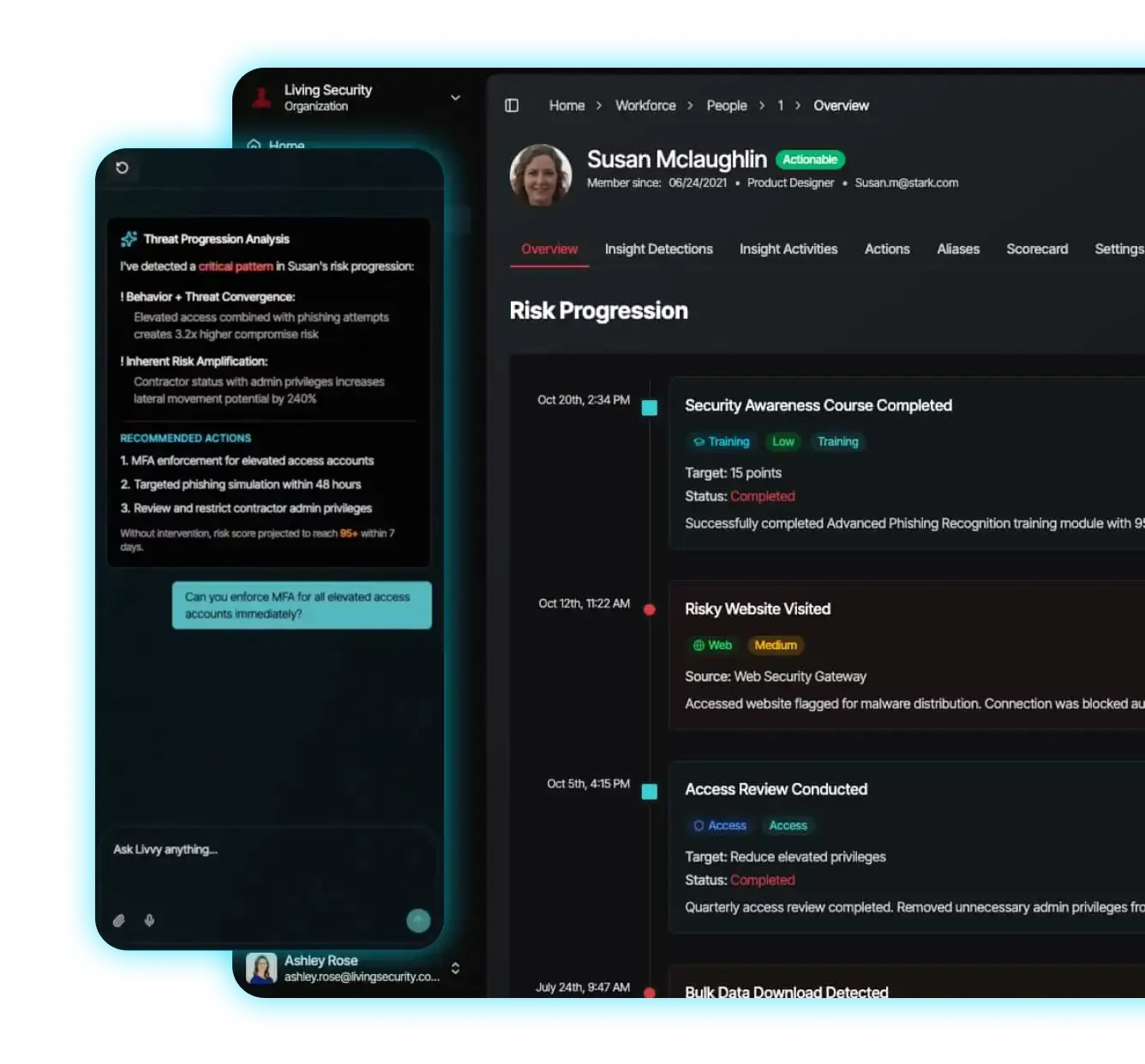
Your security tools generate a massive amount of data, but this information often lives in silos. You see alerts from endpoint protection, access logs from your identity provider, and intelligence from threat feeds. The problem? These data points are rarely correlated, creating blind spots where cybersecurity human risk hides and grows. This makes it nearly impossible to answer a critical question: how do you measure human cyber risk proactively? This definitive guide explains how to connect these disparate signals—user behavior, identity privileges, and threat intelligence—to build a complete picture of your vulnerabilities.
Key Takeaways
- Treat human error as a strategic problem, not a training issue: With 74% of security leaders calling it their top vulnerability, it is clear that generic awareness campaigns are not enough. A modern approach requires understanding the root causes of risky behavior, from knowledge gaps to cultural weaknesses.
- Predict risk by analyzing the complete picture: A true understanding of your vulnerabilities comes from correlating data across three pillars: user behavior, identity and access, and active threats. This holistic view allows you to identify your highest-risk individuals and agents before an incident occurs.
- Use an AI-native platform to act on insights at scale: Manually analyzing millions of signals is impossible. An AI-native system can predict risk trajectories and autonomously deliver targeted interventions like micro-training, all with human oversight, to prevent breaches proactively.
What is Human Cybersecurity Risk?
Human cybersecurity risk is the potential for people inside your organization to cause a security breach, whether by accident or with intent. This isn’t about assigning blame; it’s about acknowledging that human action is a critical variable in your security posture. When left unmanaged, this risk can lead to significant financial loss, damage to your brand’s reputation, and the exposure of sensitive corporate data. As technology becomes more woven into every business function, managing the human element is no longer optional. It is an essential component of a modern, comprehensive defense strategy.
Defining the Core Components: Threat, Vulnerability, and Risk
To effectively manage human risk, it’s essential to speak the same language. The terms threat, vulnerability, and risk are often used interchangeably, but they represent distinct concepts. Understanding the difference is the first step toward building a precise, data-driven security strategy. When you can clearly distinguish between a weakness, the actor who might exploit it, and the actual likelihood of an incident, you can move from a reactive posture to a predictive one. This clarity allows you to allocate resources effectively and implement targeted interventions where they will have the greatest impact on your security posture.
Vulnerability: A Weakness in Your Defenses
A vulnerability is an inherent weakness or gap in your security defenses that could be exploited. In the context of human risk, these are not software flaws but behavioral or knowledge-based gaps. For example, an employee who consistently uses weak, easily guessable passwords creates a vulnerability. Another common vulnerability is a lack of awareness that leads someone to click on a phishing link without a second thought. These weaknesses represent potential entry points for threats, but on their own, they are simply dormant flaws waiting for an external factor to act upon them and cause harm.
Threat: An Actor That Can Exploit a Weakness
A threat is any person or event with the potential to harm your organization by exploiting a vulnerability. Threats can be malicious, like a cybercriminal launching a targeted spear-phishing campaign to steal credentials. They can also be unintentional, such as a well-meaning employee who accidentally emails a sensitive document to the wrong recipient. The key distinction is that a threat is the active agent. Whether it’s a sophisticated external attacker or an internal employee making an honest mistake, the threat is the catalyst that turns a passive vulnerability into an active problem for your security team to manage.
Risk: The Intersection of Threat and Vulnerability
Risk is the probability that a specific threat will exploit a particular vulnerability and the resulting business impact of that event. It is the calculated intersection of the two. For instance, you have a vulnerability (an employee with access to sensitive data who is prone to phishing) and a threat (an active phishing campaign targeting your industry). The risk is the likelihood that this specific employee will fall for the scam, leading to a data breach. True Human Risk Management quantifies this by correlating data across employee behavior, identity and access systems, and real-time threat intelligence to predict and prevent incidents before they happen.
How People Drive Most Security Breaches
Many security incidents are not the result of complex technological failures, but of simple human mistakes. Common vulnerabilities often arise from everyday behaviors, like an employee clicking a malicious link in a phishing email, unintentionally sharing credentials, or falling for a social engineering tactic. In fact, many security leaders now list human error as their organization's single greatest vulnerability. These risks are deeply embedded in how your teams interact with technology and data. Recognizing this human factor is the first step toward building a more resilient security program that accounts for how people actually work.
Why You Can't Afford to Ignore Human Risk
The focus on human risk is not just a passing trend; it's a critical shift in security strategy. A staggering 74% of CISOs identify human error as their top cybersecurity risk, a statistic that highlights an urgent need for action. For too long, organizations have operated with a major blind spot. Security tools generate vast amounts of data, but this information is rarely correlated to create a clear, proactive view of human-driven threats. This gap means you are often reacting to incidents instead of preventing them. Prioritizing Human Risk Management allows you to move beyond reactive measures and build a security framework that truly understands and protects its most valuable asset: its people.
The Staggering Financial Impact of Insider Incidents
The financial consequences of overlooking human risk are immense. According to recent research, one incident caused by an insider costs an average of $13.1 million. With organizations experiencing multiple incidents each month, these costs can quickly spiral into hundreds of millions annually. This figure extends far beyond the immediate financial loss, encompassing regulatory fines, prolonged legal battles, operational downtime, and the erosion of customer trust. This is not just a security problem; it is a significant business liability that directly impacts the bottom line. The sheer scale of this financial drain makes it clear that a reactive approach to security, where teams wait for an incident to happen, is no longer a sustainable strategy for any modern enterprise.
What Are the Root Causes of Human Risk?
Human risk isn't a single point of failure. It’s a complex issue that stems from a combination of factors, from simple mistakes to systemic cultural problems. Understanding these root causes is the first step toward building a proactive security strategy. When you can identify why an employee might make a risky decision, you can move from simply reacting to breaches to actively predicting and preventing them.
Most security incidents involving people aren't caused by malicious intent. They're often the result of everyday human tendencies: a moment of distraction, a gap in knowledge, or pressure to get a task done quickly. By dissecting the primary drivers of human risk, you can start to see the patterns that lead to vulnerabilities. This allows you to build a program that addresses the cause, not just the symptom, and ultimately strengthens your entire security posture.
When Good Employees Make Costly Mistakes
The most common source of human risk is simple, unintentional error. This is the employee who clicks a convincing phishing link, accidentally shares sensitive data in a public channel, or misconfigures a cloud setting because they were rushing to meet a deadline. These actions aren't driven by malice but by oversight or a lack of awareness. A single mistake can create a significant security problem, potentially leading to data loss, financial damage, or reputational harm. The challenge for security teams is that these errors are unpredictable and can happen to anyone, from a new hire to a senior executive.
How Security Awareness Gaps Create Vulnerabilities
Many accidental errors happen because traditional security training falls short. Annual, check-the-box awareness programs often fail to change long-term behavior. Employees sit through generic presentations but don't retain the information or understand how it applies to their specific roles. This knowledge gap leaves them unprepared to spot sophisticated social engineering attacks or handle sensitive data correctly. Without continuous, relevant education that reinforces secure habits, employees are left to navigate a complex threat landscape on their own, making them more likely to make a critical mistake when faced with a real-world threat.
The Readiness Gap: Knowing vs. Doing
There is a significant gap between knowing about human risk and actively managing it. While nearly all organizations acknowledge their security is incomplete, very few take consistent action. According to recent research, 96% of organizations know their security isn't complete, and 91% struggle with policy adherence. Yet, only 28% combine regular security education with continuous threat monitoring. This disconnect highlights a critical failure: awareness alone does not lead to secure behavior. Closing this gap requires moving beyond annual training and implementing a system that can measure human risk in real time and deliver targeted interventions that actually change how people act.
Over-Reliance on Default Security Settings
Another common root cause of human risk is placing too much faith in technology's default settings. Many security incidents are not the result of complex technological failures, but of simple human mistakes. Common vulnerabilities often arise from everyday behaviors, like an employee clicking a malicious link in a phishing email, unintentionally sharing credentials, or falling for a social engineering tactic. These actions can easily bypass standard security configurations. A proactive security strategy cannot simply rely on out-of-the-box tools; it must account for the unpredictable nature of human behavior and integrate phishing simulations and other behavioral insights to build a more resilient defense.
The Compliance Consequences of Unmanaged Human Risk
Failing to address human risk is not just a security oversight; it is a growing compliance liability. Regulators and auditors are increasingly scrutinizing how organizations manage the human element of their security programs. Human risk is not a single point of failure. It is a complex issue that stems from a combination of factors, from simple mistakes to systemic cultural problems. A check-the-box training program is no longer sufficient to demonstrate due diligence. Organizations must now prove they have a mature, data-driven approach to identifying, measuring, and mitigating human-driven threats, aligning with a comprehensive Human Risk Management maturity model to satisfy modern compliance standards.
The True Cost of a Poor Security Culture
A company’s culture plays a huge role in its security posture. When security is viewed as an obstacle or solely the IT team's responsibility, employees are less likely to be vigilant. A weak security culture can lead to employees bypassing security controls to save time, failing to report suspicious incidents for fear of getting in trouble, or ignoring policies they see as inconvenient. In contrast, a strong culture makes security a shared value. It empowers everyone to act as a line of defense, fostering an environment where people feel comfortable asking questions and proactively reporting potential threats.
Identifying and Mitigating Malicious Insider Threats
While less frequent than accidental errors, intentional threats from malicious insiders pose a severe risk. This could be a disgruntled employee selling company data, a departing team member stealing intellectual property, or an individual deliberately sabotaging systems. These actors often have legitimate access to sensitive information, making their actions difficult to detect with traditional security tools. Identifying malicious intent requires a more sophisticated approach, one that can correlate unusual digital behaviors with access levels and known threats to flag anomalies before they escalate into a full-blown incident.
The Psychology of Malicious Behavior
Most cybersecurity risk assessments are built to analyze technology, not people. They excel at identifying malicious software but often fail to address the human intent behind an attack. To build a truly proactive defense, security leaders must shift their focus to understanding the psychology of maliciousness. Research from Frontiers in Psychology highlights that characterizing and measuring malicious intent is a critical, yet often overlooked, component of risk assessment. Instead of only reacting to the tools an attacker uses, a modern security program must be able to predict who is most likely to act and why. This requires a deep analysis of the behavioral and psychological precursors that signal escalating risk.
Individual and Micro-Level Drivers of Intentional Harm
Intentional harm is rarely a spontaneous event. It is typically driven by a set of individual, micro-level factors that can include financial pressure, professional grievances, ideological motives, or personal distress. A financially struggling employee might be more susceptible to a bribe, while a passed-over manager could be motivated by revenge. These internal drivers manifest as subtle shifts in digital behavior long before an incident occurs. The challenge is that traditional security tools, which are designed to find known threats, are not equipped to interpret the human intention to cause harm. This is why correlating behavioral signals with identity data and threat intelligence is essential for identifying individuals on a high-risk trajectory.
How Group and Societal Influences Shape Malicious Intent
An individual’s actions are often shaped by the groups they belong to, both inside and outside the organization. A strong sense of affiliation with a particular online community or hacktivist group can create a moral framework that justifies actions harmful to an employer. Within the company, a toxic team environment or a feeling of alienation can push an employee toward malicious behavior. These group dynamics create powerful undercurrents that can influence an individual’s loyalty and intent. A comprehensive Human Risk Management strategy must account for these external and internal social pressures, recognizing that an employee’s risk profile is not defined in a vacuum but is influenced by a complex web of relationships and beliefs.
How Does Human Error Fuel Security Incidents?
Human error is more than just an occasional slip-up; it's a primary driver of security incidents. A single mistake, whether it's a clicked link or a misconfigured cloud server, can create an opening for significant disruption. Understanding the specific ways these errors occur and their true impact is the first step toward building a more resilient security posture. It requires moving past blame and focusing on the systemic factors that allow these mistakes to happen in the first place.
By the Numbers: The Impact of Human-Driven Breaches
When security leaders are asked about their biggest concerns, the answer is overwhelmingly consistent. According to IBM, 74% of CISOs identify human error as the single greatest risk to their organizations. This isn't just a perception; it's a reality reflected in breach reports year after year. The "human element" is a factor in the vast majority of security incidents, from phishing and credential theft to insider threats. Recognizing this reality is critical for any effective security strategy. It shifts the focus from a purely technology-centric view to a more holistic approach that incorporates Human Risk Management as a core discipline, acknowledging that your people are a key part of your defense system.
The Rise of Phishing, BEC, and Collaboration Tool Attacks
Attackers have long understood that the easiest way into an organization is through its people, which is why phishing and Business Email Compromise (BEC) attacks remain so effective. The threat landscape is also expanding beyond the inbox. While 96% of organizations anticipate email security problems, a significant 71% also expect attacks targeting popular collaboration tools. These platforms are prime targets because they are built on trust and rapid communication, making it easier for attackers to impersonate colleagues or executives and trick employees into sharing credentials or transferring funds. Each successful attack reinforces a critical point: the human element is not a fringe issue but the central battleground for enterprise security.
Which Employee Mistakes Cost the Most?
The mistakes that lead to breaches are often mundane. They can be simple typos in an email address, risky choices made by developers under pressure, or the use of unauthorized tools that create unseen vulnerabilities. While traditional security awareness training aims to address these behaviors, its effectiveness can be limited. For example, research shows that the improvements gained from phishing simulations tend to plateau after a dozen or so sessions. This indicates a need for a more dynamic and continuous approach. The costliest errors are often the ones that go unnoticed until it's too late, stemming from ingrained habits or gaps in knowledge that generic, one-size-fits-all training fails to correct.
Emerging Threats: From Shadow AI to Typosquatting
The threat landscape is constantly evolving, moving beyond predictable phishing campaigns to exploit more subtle human behaviors. One growing risk is "Shadow AI," where employees use unapproved generative AI tools to accelerate their work, unintentionally feeding them sensitive company data and creating a new, unmonitored attack surface. At the same time, classic threats like typosquatting remain highly effective. This tactic relies on attackers registering domains that are common misspellings of legitimate sites, waiting for an employee to make a simple typing mistake. Both threats exploit the same core vulnerability: everyday human actions. Understanding these patterns is the first step toward building a security program that can predict and prevent incidents before a minor error becomes a major breach.
The Dual Threat of AI: Defensive Gaps and Offensive Attacks
Artificial intelligence presents a two-sided challenge for security teams. On one hand, attackers are using AI to launch sophisticated, automated attacks. Generative AI can create hyper-realistic phishing emails and deepfakes that are nearly impossible for the untrained eye to spot. With most security leaders expecting AI-powered attacks to become common, the need for a proactive defense has never been greater. On the other hand, as organizations adopt AI tools, they introduce new internal risks. These AI agents interact with sensitive systems and data, becoming potential targets themselves. A modern security strategy must account for this dual threat, managing the risk posed by both human employees and the AI agents they use.
Beyond the Breach: The Ripple Effect of a Single Mistake
The consequences of a human-driven breach extend far beyond the initial incident. A single mistake can trigger a cascade of negative outcomes, including operational downtime, loss of customer trust, and significant financial penalties. For organizations in critical sectors, the impact can be even more severe, disrupting essential services and affecting vulnerable communities. While an individual may be the one who makes the error, the responsibility lies with the organization to create a system that prevents such mistakes from becoming catastrophic. Building a security-first culture, supported by a predictive platform, helps create layers of defense that account for human fallibility and reduce the potential for widespread damage.
What Behaviors Signal a High-Risk User?
To effectively manage human risk, you need to move beyond tracking isolated incidents and start identifying the underlying patterns that signal potential threats. True risk isn't just about one employee clicking one bad link; it's about the recurring behaviors, access vulnerabilities, and threat responses that create a predictable path to a breach. By analyzing signals across your organization, you can spot these high-risk patterns before they lead to a security event. Understanding these trends is the first step toward building a predictive security strategy that stops threats before they start.
How to Spot Risky Digital Habits
Many of your most significant security vulnerabilities originate from employee behavior. Actions like repeatedly falling for phishing simulations, using weak or recycled passwords, and downloading unapproved software are clear indicators of risk. These aren't just isolated mistakes; they are observable habits that create consistent entry points for attackers. When you correlate these actions with other data, you can see which individuals or groups are most likely to cause an incident. The goal isn't to place blame but to gain the visibility needed to intervene with targeted training or policy adjustments, turning a reactive problem into a proactive solution.
Find Your Identity and Access Management Gaps
An employee's digital behavior becomes exponentially more dangerous when combined with excessive or improperly managed access privileges. Vulnerabilities often hide in plain sight, created by things like privilege creep, where users accumulate access rights far beyond their job requirements. Other common issues include developers making risky configuration choices or employees using unauthorized tools that introduce new shadow IT risks. A single behavioral slip from a user with administrative credentials can have a far greater impact than the same mistake from an entry-level employee. This is why a comprehensive Human Risk Management strategy must analyze identity and access data alongside behavioral trends to quantify the potential blast radius of an incident.
What Threat Response Patterns Reveal About Risk
How your team responds to potential threats is just as important as their day-to-day digital habits. A pattern of ignoring security alerts, failing to report suspicious emails, or consistently mishandling sensitive data points to critical gaps in your security culture and training effectiveness. With human error cited as a top concern by 74% of security leaders, it’s clear that organizations need better systems to guide employees toward secure actions. Analyzing these response patterns helps you understand why mistakes happen. It allows you to move past simple pass-fail training and develop a system that provides real-time guidance and reinforcement, building a more resilient workforce.
Predict and Prevent: A New Approach to Human Risk
Moving beyond a reactive security posture is essential for protecting your organization. Instead of waiting for an incident to happen, you can get ahead of threats by understanding and predicting the behaviors that cause them. This proactive approach doesn't just reduce breaches; it builds a more resilient security culture from the ground up. It requires a fundamental shift in how you view, analyze, and manage the human element of your security program. By focusing on prediction and prevention, you can stop incidents before they ever start.
Make the Shift to a Predictive Security Model
Traditional security awareness training, with its annual check-the-box exercises, is no longer sufficient. A smarter approach requires looking at behavior, context, and specific situations to understand risk. The goal is to move from a "detect and respond" model to a "predict and prevent" framework. This means you stop chasing alerts and start identifying the risk trajectories of individuals and AI agents within your organization. By understanding who is most likely to cause an incident, you can intervene with targeted actions before a mistake happens. This is the core of a modern Human Risk Management strategy, turning your security program into a proactive, data-driven function.
The Three Signal Types That Predict Risk
To accurately predict risk, you need a complete picture. Analyzing behavioral data alone, like phishing click rates, only tells you part of the story. A comprehensive view comes from correlating data across three key pillars: human behavior, identity and access, and real-world threats. For example, an employee who repeatedly fails phishing tests is a concern. But if that same employee also has administrative access to critical systems and is actively being targeted by a threat actor, their risk profile becomes critical. By integrating these disparate signals, you can pinpoint your most vulnerable points and prioritize your resources where they will have the greatest impact on your security posture.
How an AI-Native Platform Predicts Future Incidents
Analyzing millions of data points across behavior, identity, and threats is impossible to do manually. This is where an AI-native platform becomes a critical asset. With 87% of CISOs looking to use AI to protect against human error, the right technology can transform your approach. An AI-native platform is built from the ground up to analyze complex signals and predict outcomes. It can identify emerging threats, provide evidence-based recommendations, and even act autonomously to deliver micro-training or adjust policies. With AI handling routine tasks under human oversight, your team is free to focus on strategic initiatives, confident that risks are being managed proactively and efficiently.
Which Training Methods Actually Reduce Human Risk?
Traditional security training often misses the mark. Annual compliance videos and generic phishing tests might check a box for auditors, but they rarely lead to a measurable reduction in human risk. To truly change behavior, you need to move beyond awareness and focus on building secure habits. This requires a strategic shift from one-off events to a continuous, data-driven program that adapts to your employees and the evolving threat landscape.
Effective training isn’t about scaring people into compliance. It’s about empowering them with the right knowledge at the right time. The most successful programs are personalized, contextual, and integrated into the daily workflow. They treat employees as a critical part of the security solution, not just the problem. By focusing on methods that provide real-time feedback, tailor content to individual roles, and foster a collective sense of responsibility, you can transform your training from a passive requirement into an active defense mechanism that strengthens your entire security posture.
The Plateau of Traditional Security Training
Many accidental errors happen because traditional security training falls short. Annual, check-the-box awareness programs often fail to change long-term behavior. Employees sit through generic presentations but do not retain the information or understand how it applies to their specific roles. This knowledge gap leaves them unprepared to spot sophisticated social engineering attacks or handle sensitive data correctly. Without continuous, relevant education that reinforces secure habits, employees are left to navigate a complex threat landscape on their own. This makes them more likely to make a critical mistake when faced with a real-world threat, proving that awareness alone is not enough to build a resilient defense.
Why Phishing Simulations Have Diminishing Returns
While phishing tests are a staple in security programs, their effectiveness has a ceiling. Research shows that the improvements gained from these simulations tend to plateau after about a dozen sessions. Employees become conditioned to spot the specific patterns of your internal tests, but this does not always translate to identifying novel or highly sophisticated real-world attacks. This creates a false sense of security, where training metrics look good, but actual risk remains high. A more dynamic approach to phishing awareness is needed, one that moves beyond simple pass-fail rates and focuses on building critical thinking skills that adapt to evolving threats.
How One Successful Attack Undoes Training Progress
The greatest weakness of a training-only approach is its fragility. You can achieve a 99% success rate on phishing tests, but a single mistake from the remaining 1% can create a significant security problem. That one click can lead to catastrophic data loss, financial damage, or harm to your company's reputation. The challenge is that these errors are unpredictable and can happen to anyone, from a new hire to a senior executive. This is why a modern security strategy must go beyond training and predict where the most impactful mistakes are likely to occur, allowing you to intervene before that one costly click happens.
Why Real-Time Guidance Outperforms Simulations
Phishing simulations are a valuable tool, but their true power is unlocked when they are part of a larger feedback loop. Simply telling an employee they failed a test weeks later does little to correct the behavior in the moment. The key is to provide immediate, contextual guidance. Studies show that real-time training interventions directly correlate with a reduction in security alerts over time. When an employee clicks a simulated phishing link or attempts to visit a risky website, a well-timed nudge or a two-minute micro-training can correct the action and reinforce the right behavior instantly. This approach transforms a mistake into a powerful learning opportunity, building muscle memory for secure decision-making.
Create Role-Specific, Targeted Security Training
A one-size-fits-all training program is fundamentally flawed because risk is not one-size-fits-all. A C-suite executive with broad system access faces entirely different threats than an engineer working in a development environment. To be effective, security awareness and training must be nuanced and relevant to an individual’s role, access level, and specific behaviors. By correlating data across behavior, identity, and threat intelligence, you can identify which employees are most at risk and why. This allows you to deliver targeted training that addresses their unique vulnerabilities, making the content more engaging and far more likely to stick.
Implement Continuous Micro-Training That Sticks
The "forgetting curve" is steep. Most employees will forget the majority of what they learned in an annual training session within a few weeks. A more effective strategy is to deliver regular, short training sessions throughout the year. This micro-training approach keeps security top-of-mind without overwhelming employees or disrupting their productivity. A short video on identifying deepfakes or a quick quiz on password hygiene, delivered monthly, reinforces key concepts and builds a continuous learning habit. This consistent reinforcement is critical for developing the lasting behavioral changes that actually reduce risk.
How to Build a Resilient, Security-First Culture
Technology and training are essential, but the ultimate goal is to create a culture where every employee feels a personal sense of ownership over security. This starts with clear communication and buy-in from leadership, but it must extend throughout the organization. When security is seen as a shared responsibility rather than just an IT problem, people become more proactive. Fostering this culture involves celebrating security champions, making it easy for employees to report potential threats, and framing security as a collective effort to protect the company and its customers. An effective Human Risk Management program provides the foundation for this cultural shift.
How to Measure the Reduction of Human Risk
To truly understand the impact of your security program, you need to move beyond simple completion rates and compliance checkboxes. Measuring human risk reduction is about connecting your efforts to tangible security outcomes. It’s how you prove the value of your program and make data-driven decisions to strengthen your organization's defenses. Effective measurement isn’t just about looking at past performance; it’s about understanding current risk levels and predicting future vulnerabilities.
A robust measurement strategy provides a clear, quantitative view of your security posture. It allows you to see which interventions are working, identify where gaps still exist, and demonstrate progress to leadership. By focusing on the right metrics, you can shift the conversation from training activity to actual risk reduction. This involves defining specific goals, tracking how employees engage with your security initiatives, and measuring the direct impact on their behavior over time. This approach transforms your security program from a cost center into a strategic asset that actively protects the business from evolving threats.
Set the Right KPIs to Track Behavioral Change
You can't improve what you don't measure. The first step is to establish clear Key Performance Indicators (KPIs) that align directly with your organization's security objectives. Instead of focusing on vanity metrics like how many employees completed a training module, concentrate on metrics that reflect real behavioral change. For example, track the reduction in clicks on phishing simulations, the decrease in reported policy violations, or an increase in employees proactively reporting suspicious emails. These behavioral metrics provide direct evidence that your program is building a more resilient security culture. By correlating data across behavior, identity, and threats, you can create KPIs that offer a holistic view of human risk.
Measure the True Impact of Your Security Training
A truly effective security program embeds itself into the company culture, and measuring this requires looking beyond formal training campaigns. Are employees participating in optional security events like lunch-and-learns? Are they asking thoughtful questions or sharing security tips with their peers? These engagement activities are powerful indicators that your message is resonating. Tracking metrics like attendance at voluntary sessions or traffic to internal security resource pages can reveal how deeply security awareness has penetrated the organization. This data helps you understand not just if employees are compliant, but if they are genuinely engaged in becoming security partners.
How to Validate Your Prediction Accuracy and Risk Models
The ultimate goal is to see a quantifiable reduction in security incidents. By using metrics to track progress over time, you can assess the real-world effectiveness of your security initiatives. Key measures include a decrease in the number and severity of security incidents caused by human error and improvements in response times. A predictive Human Risk Management platform takes this a step further. It allows you to monitor risk trajectories for individuals and departments, showing how targeted interventions lower the probability of a future incident. This proactive approach allows you to measure not just past performance but the accuracy of your risk predictions, proving you can stop threats before they materialize.
What Technology Delivers Predictive Human Risk Management?
While training is essential, technology is what allows you to manage human risk at scale. Traditional security tools are often reactive, flagging an issue only after an employee clicks a malicious link or mishandles sensitive data. This approach leaves your organization constantly playing defense, responding to fires instead of preventing them. A modern strategy requires a technological shift from detection to prediction, using a platform that can anticipate and prevent incidents before they occur. This means moving beyond isolated point solutions and adopting an integrated system that understands the full context of human and AI agent behavior.
The right technology provides security teams with clear, actionable visibility into risk across the entire organization. It moves beyond simple pass or fail metrics from a phishing simulation. Instead, it correlates data from multiple systems to build a comprehensive picture of risk for every individual and AI agent. This allows you to see who is most vulnerable, who has the most critical access, and who is being actively targeted by threats. By leveraging behavioral analytics, implementing autonomous responses, and using AI with human oversight, you can build a proactive defense that effectively mitigates human risk. This data-driven approach helps you make smarter investments, refine security policies, and focus your team’s efforts where they will have the greatest impact.
Use Behavioral Analytics to Understand User Intent
To effectively manage human risk, you must first understand it. Behavioral analytics provides the foundation for this understanding by analyzing vast amounts of data to identify patterns and predict outcomes. A comprehensive Human Risk Management platform ingests and correlates signals from three critical pillars: user behavior, identity and access systems, and real-world threat intelligence. By analyzing this correlated data, you can see which employees are engaging in risky activities, who has access to sensitive systems, and who is being targeted by attackers. This holistic view allows security teams to pinpoint their most significant vulnerabilities and prioritize interventions, ensuring resources are focused on the highest-impact risks.
How Autonomous Actions Prevent Incidents Before They Happen
Identifying risk is only half the battle. The next step is taking action, and doing so manually is not scalable for a modern enterprise. Security solutions should not just highlight problems; they must provide clear pathways to predict and prevent threats before they happen. An autonomous risk response system uses the insights from behavioral analytics to trigger targeted, real-time interventions. These actions can include assigning a specific micro-training module after a risky behavior is detected or sending a policy nudge to an employee handling sensitive data. The Living Security Platform automates 60 to 80% of these routine tasks with human oversight, freeing up your security team to concentrate on more complex strategic initiatives.
Combine AI-Native Prediction with Human Expertise
Artificial intelligence is the engine that powers a truly predictive human risk management strategy. With 87% of CISOs looking to use AI to protect against human error, its role in cybersecurity is becoming central. An AI-native platform can process billions of data points across behavior, identity, and threat signals to predict which users are on a high-risk trajectory. This allows you to intervene before a mistake leads to a breach. An AI guide can provide your team with explainable, evidence-based recommendations and confidence scores, ensuring every action is transparent and justified. This approach, which combines powerful AI with human oversight, creates a proactive security posture that continuously adapts to your organization’s unique risk landscape.
How to Build Your Human Risk Management Strategy
Moving from understanding risk to actively preventing it requires a clear, actionable plan. A successful Human Risk Management (HRM) strategy isn't just about deploying new software; it's a comprehensive framework that integrates technology, shapes culture, and produces measurable results. This strategic approach marks a significant shift away from reactive, compliance-driven training toward a proactive model of risk reduction. It’s about creating a system that continuously learns and adapts to your organization's unique risk landscape, turning abstract risk data into concrete preventative actions. Without a formal strategy, risk reduction efforts often become fragmented, inconsistent, and difficult to measure. You might run phishing simulations or assign annual training, but these isolated tactics fail to address the root causes of human risk. A well-defined strategy ensures your efforts are aligned, sustainable, and directly tied to business outcomes. Building this strategy involves outlining your core components, getting executive support, and preparing for common hurdles. By focusing on these key areas, you can create a program that not only reduces incidents but also builds a more resilient, security-conscious organization from the ground up. This is how you move from simply managing incidents to truly managing risk.
Map Out Your Core Program Components
A modern Human Risk Management program moves far beyond annual compliance training. It’s a continuous cycle of identifying, assessing, and mitigating risks tied to people. Your strategy should outline how you will gain a deep understanding of employee behaviors and the specific contexts that lead to risky decisions. This means defining how you will correlate data across different sources, including behavioral patterns, identity and access permissions, and real-world threat intelligence. The goal is to build a complete picture of your risk landscape, allowing you to prioritize the most critical vulnerabilities and apply the right interventions for the right people at the right time.
Get Executive Buy-In for a Security Culture Shift
A security-first culture doesn't happen by accident; it’s cultivated from the top down. Your strategy must include a plan for securing buy-in from executive leadership. This involves framing cybersecurity not as a technical problem for the security team to solve, but as a collective responsibility essential to the business's success. When leaders consistently communicate that every employee plays a vital role in protecting the organization, it transforms the company culture. This executive sponsorship is crucial for securing the resources and authority needed to implement meaningful, organization-wide changes that make security an integral part of everyone's job.
Anticipate and Solve Common Implementation Hurdles
Transitioning from basic security awareness to a sophisticated HRM program comes with its own set of challenges. Many organizations struggle to move beyond generic training modules that fail to change long-term behavior. A successful strategy anticipates this by focusing on people rather than just tools. Instead of one-size-fits-all training, the plan should center on delivering personalized, real-time interventions based on individual risk signals. Leveraging an AI-native platform can help you overcome these hurdles by automating the analysis of complex data and delivering targeted actions with human oversight, making your risk reduction efforts both scalable and effective.
Frequently Asked Questions
How is Human Risk Management (HRM) different from traditional security awareness training?
Think of traditional security awareness as an annual driver's ed class. It covers the basics, but it doesn't account for what happens on the road every day. Human Risk Management, on the other hand, is like having a modern navigation system that analyzes real-time traffic, suggests better routes, and provides immediate alerts. HRM is a continuous, data-driven strategy that predicts and prevents incidents by understanding the specific behaviors, access levels, and threats relevant to each person, rather than relying on generic, one-size-fits-all training.
My security team is already stretched thin. How does an HRM platform help without adding more work?
This is a common concern, and it's exactly why a modern HRM platform is designed to reduce your team's workload, not add to it. The platform's AI engine automates the heavy lifting of data analysis and routine remediation. It autonomously handles 60 to 80% of tasks like assigning targeted micro-trainings or sending policy nudges, all with human oversight. This frees your team from chasing down low-level alerts so they can focus on high-impact strategic initiatives.
What kind of data does the platform analyze to predict risk?
A predictive platform provides a complete picture by looking beyond a single data source. It correlates information across three critical pillars to understand the full context of risk. First, it analyzes user behavior, such as interactions with phishing simulations or data handling habits. Second, it examines identity and access data to see who has privileged credentials. Finally, it integrates real-world threat intelligence to identify who is being actively targeted. By combining these signals, the platform can accurately predict who is most likely to cause an incident and why.
Will this approach make employees feel like they're being constantly monitored?
The goal of HRM is to empower employees, not to police them. The focus is on providing supportive, real-time guidance to help people make safer decisions. Instead of being punitive, the interventions are contextual and educational, like a quick training nudge after a risky action. When framed as a program designed to help everyone protect the company, it fosters a shared sense of responsibility and builds a stronger security culture, rather than creating a feeling of surveillance.
How can I measure the return on investment of an HRM program?
The ROI of an HRM program is measured through tangible reductions in security incidents and their associated costs. You can track clear key performance indicators, such as a decrease in successful phishing attacks, fewer policy violations, and faster incident response times. A predictive platform also allows you to measure the reduction in your organization's overall risk trajectory over time. This provides you with clear, quantifiable data to demonstrate to leadership how your program is proactively preventing breaches and strengthening the company's security posture.