

Blogs  Human Risk Quantification...
.jpeg?width=32&height=32&name=047-FjykSoq-Wa8%20(1).jpeg)
Your phish-prone percentage is down and training completion is at an all-time high, but are you actually more secure? Traditional security awareness metrics often create a false sense of security. They fail to answer the most important question: who are your riskiest people and what is their potential impact on the business? To get a true measure, you must move beyond surface-level data. A modern approach requires correlating employee behaviors with their access to critical systems and the real-world threats targeting them. This is how you create a meaningful Human Risk Index that allows you to prioritize and mitigate your most significant vulnerabilities.
 The cybersecurity industry has shifted; gone are the days of relying on compliance based security awareness and training. Forrester has predicted that 90% of data breaches will include the human element in 2024 (Forrester, 2023). Consequently, there is a growing urgency for organizations to identify and mitigate human risks to bolster their overall security. Not only acknowledging human risks, but understanding how to quantify them, is a vital step in implementing a human risk management approach for your organization’s cybersecurity.
Understanding the Fundamentals of Risk Quantification
To effectively manage human risk, you first need a way to measure it. Risk quantification is the process of assigning a value to risk, helping you prioritize threats and allocate resources efficiently. While traditional methods offer a basic framework, they fall short when applied to the complex and unpredictable nature of human behavior. Modern approaches, however, analyze vast datasets to provide a much clearer picture. Let's break down the core concepts you need to know to quantify human risk in a way that drives real security outcomes for your enterprise.
The Basic Risk Calculation Formula: Probability x Impact
At its core, risk quantification often starts with a simple formula: Probability multiplied by Impact. Probability is the likelihood of an incident occurring, while Impact represents the potential damage. For example, if the probability of an employee falling for a phishing email is high (a 4 out of 5) and the potential impact is medium (a 3 out of 5), the risk score is 12. This calculation provides a straightforward way to compare different risks. However, this static model struggles to capture the dynamic nature of human risk, which is influenced by constantly changing factors like employee access levels and evolving threat landscapes.
Qualitative vs. Quantitative Risk Scores
Risk scores can be qualitative or quantitative. Qualitative analysis uses descriptive labels like "Low," "Medium," and "High" to categorize risk. This method is intuitive but lacks the precision needed for strategic decisions. Quantitative analysis uses specific numerical values, such as monetary loss or percentages, to provide objective, data-driven metrics for leadership. The historical challenge has been gathering the right data for accurate quantitative analysis of human actions. Modern Human Risk Management platforms solve this by turning behavioral, identity, and threat signals into measurable outcomes.
The Importance of Establishing Clear Definitions
A risk score is only meaningful if everyone agrees on what it represents. Your security, IT, and leadership teams must have a shared understanding of terms like "High Impact." Does it mean a $1 million loss or a $10 million loss? Establishing a clear framework for how risks are defined and scored ensures consistency across your organization. This alignment is a foundational step in building a mature security program. When everyone speaks the same language about risk, you can have more productive conversations about priorities and prove the value of your security initiatives with data everyone trusts. A well-defined risk management model helps create this common language.
What is the Importance of Risk Quantification when building your HRM Strategy?
Humans are, by definition, the source of human risks within each organization, contributing to 82% of data breaches, according to the 2022 Verizon Data Breach Investigations Report. Their everyday behaviors, decisions, and actions can affect an organization’s overall security. By transforming data surrounding human behaviors—including their levels of data access and the frequency of targeted cybersecurity attacks—into quantifiable, measurable metrics, organizations can objectively identify the impact of various risks and prioritize potential threats, allowing for clearer, more effective risk management and mitigation strategies.
This data-driven approach allows organizations to pinpoint their biggest security threats targeting their workforce, improve decision-making, and tailor interventions based on the impact a threat imposes. While valuable insights like siloed risk metrics and training completion rates promote accountability within individual teams and the organization as a whole, they focus on isolated aspects of risk. By marrying risk data to quantify human risks, organizations can better understand human risks according to their impact on the organization. This comprehensive approach supports an efficient and proactive risk management strategy across the entire organization.
### Framing Human Risk as a Core Business Risk
Shifting the perspective on human risk is the first step. It’s not just a problem for the IT department; it’s a core business risk that impacts the entire organization. With human error contributing to over 95% of successful cyberattacks, the actions of your workforce have a direct line to your bottom line, operational stability, and brand reputation. Quantifying this risk translates abstract threats into concrete business terms that leadership can understand and act upon. This approach moves the conversation from technical jargon to measurable outcomes, allowing security leaders to demonstrate the value of their programs and secure the resources needed to protect the organization effectively.
### Meeting Compliance and Regulatory MandatesBeyond internal security posture, quantifying human risk is essential for regulatory compliance. Mandates like GDPR and HIPAA require organizations to demonstrate diligent management of how employees access and handle sensitive data. Simply running a training campaign is no longer enough. You need to provide auditable proof that you are identifying, measuring, and mitigating human risk. A quantitative approach provides clear, evidence-based reporting that satisfies auditors and regulators. This documentation not only helps your organization meet compliance requirements but also protects it from potential fines and legal repercussions associated with data mismanagement.
Common Metrics and Data Sources for Human Risk
To effectively quantify human risk, you must move beyond surface-level metrics like training completion rates. While these numbers show engagement, they don't measure actual behavioral change or risk reduction. A mature Human Risk Management strategy requires a deeper look, pulling from diverse data sources to build a comprehensive picture of your risk landscape. The goal is to understand not just what people know, but how they act, what systems they can access, and how actively they are being targeted by external threats. This is why a modern approach correlates data across three critical pillars: employee behavior, identity and access privileges, and real-world threat intelligence. By combining these data streams, you can identify your most vulnerable users and prioritize interventions where they will have the greatest impact.
Key Metrics for Initial Assessment
When beginning to quantify human risk, most organizations start with foundational metrics derived from security awareness activities. These initial assessments provide a baseline understanding of your workforce's general susceptibility to common threats. While metrics like phish-prone percentages are valuable starting points, it's important to recognize them as single data points in a much larger risk equation. They can signal potential weaknesses but lack the context to show the full potential impact of a breach. True risk quantification uses these initial metrics as a foundation, layering them with additional data to build a more accurate and actionable view of human risk.
Phish-Prone Percentage
One of the most common entry-level metrics is the phish-prone percentage. This figure represents the proportion of your employees who are likely to click on a malicious link or engage with a phishing email during a simulation. As a key performance indicator, it offers a straightforward way to gauge the effectiveness of your phishing awareness training over time. A decreasing phish-prone percentage suggests your educational efforts are working. However, this metric alone doesn't account for the fact that a single click from a high-privilege user, like a system administrator, carries significantly more risk than a click from an intern with limited access.
Time-to-Breach Estimates
A more advanced metric, the time-to-breach estimate, attempts to predict how long it might take for an attacker to successfully compromise your organization. This calculation often combines multiple factors, such as phishing susceptibility, password strength, and security awareness scores, to generate a predictive risk score. This forward-looking approach aligns with a proactive security strategy, helping you understand your defensive gaps before an incident occurs. By estimating the potential speed of an attack, you can better prioritize security controls and interventions aimed at slowing down adversaries and giving your response teams more time to act.
Essential Data Sources for a Complete View
Foundational metrics are a good start, but a truly comprehensive understanding of human risk requires integrating a wider array of data sources. To move from a reactive to a predictive security model, you need to see the full picture. This means correlating information about what your employees are doing with data on what they *can* do and the specific threats they face. By analyzing signals across employee behavior, identity and access management systems, and external threat intelligence feeds, you can uncover hidden patterns and identify high-risk individuals who might otherwise go unnoticed.
Using Dark Web Scans for Threat Intelligence
Incorporating threat intelligence from dark web scans provides critical external context for your human risk equation. These scans search underground forums and marketplaces for compromised corporate credentials, such as employee emails and passwords, that have been exposed in third-party breaches. When you collect this information, you gain direct insight into which of your employees are being actively targeted or have had their credentials compromised. This data is invaluable for identifying users who are at an elevated risk of account takeover or spear-phishing attacks, allowing you to take proactive steps like forcing password resets or providing targeted training.
Monitoring Behavior Across All Communication Channels
Human risk extends far beyond the email inbox. Employees today use a wide array of collaboration tools, cloud applications, and messaging platforms to do their jobs, and risky behaviors can occur on any of them. A holistic view of human risk requires you to monitor activity across all these channels. Are employees sharing sensitive data in a public Slack channel? Are they using unauthorized file-sharing applications? Understanding these behaviors provides a much richer, more accurate picture of your organization's risk posture and helps you tailor policies and controls to how your employees actually work.
How does Living Security Quantify Human Risk?
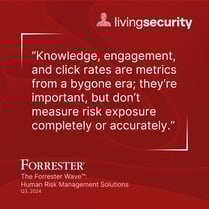
In The Forrester Wave™: Human Risk Management Solutions, Q3 2024 report, the research and advisory company suggests organizations should look to partner with an HRM provider that uses “a correct definition of risk, evaluating the likelihood and impact of harm to your organization,” followed by the reminder that “The more granular the data [the] better you will be able to measure and manage risk.” Living Security understands the weight of these recommendations, and delivers a platform that not only aligns with these principles but also empowers organizations with real-time quantified data, insights, and recommendations.
Living Security offers an advanced and comprehensive Human Risk Management platform, Unify, to does the risk quantification for you. Unify integrates existing security tools to streamline and analyze data in one platform, providing organizations with a holistic view of the combination of cyber risks their workforce faces. Unify measures over 250 individual behaviors, varying from training participation and phishing interactions, to password management and handling sensitive data. Taking into consideration variable factors including risky and vigilant behaviors, external threats, and individual access levels within the organization, Unify’s HRI (Human Risk Index) thoroughly evaluates data to provide individual and organizational risk quantification scores. By turning actions into data, human risks can be addressed and mitigated to strengthen overall security and enable organizations to stay ahead of emerging threats.
Unify - Identify | Learn More
Correlating Behavior with Identity, Access, and Threat Data
Understanding human risk requires looking at more than just behavior. An employee clicking on a phishing link is a data point, but it lacks crucial context. To accurately quantify risk, you must correlate that behavior with other key signals. The Living Security platform achieves this by analyzing data across three core pillars: behavior, identity and access, and threat. This approach transforms isolated actions into measurable metrics. It answers the critical questions: Who is the user? What critical systems and data can they access? And are they being actively targeted by external threats? By weaving these data streams together, you can objectively identify and prioritize the most significant risks based on their potential impact, creating a clear path for effective mitigation.
Moving Beyond Misleading Company-Wide Averages
Traditional security metrics, like a company-wide phish-prone percentage or training completion rates, can create a false sense of security. A 5% failure rate on a phishing test doesn’t tell you if that 5% includes your entire finance department or system administrators with privileged access. These aggregate numbers obscure where your most critical risks are concentrated. A modern Human Risk Management strategy moves beyond these siloed metrics. Instead of focusing on a single organizational score, it quantifies risk at the individual level. This allows you to see the specific people and teams that pose the highest risk, enabling you to tailor interventions and resources where they will have the greatest impact on your security posture.
Connecting High-Risk Behavior to Critical Data Access
The true measure of risk lies at the intersection of behavior and access. A mistake made by an employee with access to sensitive customer information or financial systems carries far more weight than the same mistake from someone without that access. The goal is to pinpoint exactly where high-risk behaviors overlap with access to your organization's most critical assets. This is where risk quantification becomes truly actionable. By identifying these high-impact individuals, you can implement targeted solutions, such as personalized micro-training, policy adjustments, or access reviews. This data-driven approach ensures you are focusing your efforts on preventing the incidents that could cause the most damage to your organization.
What is HRI? How Does it Assign Risk Quantification Scores?
The Human Risk Index (HRI) is Living Security's proprietary unit of measurement that uses a Bayesian Network to provide a risk score that estimates the likelihood and impact of human behaviors on overall security posture. The HRI calculates a risk score from 0-1000 by analyzing internal and external data from three key categories: user behaviors, external threats, and user access. The Human Risk Index allows your organization to directly quantify behaviors and threats to identify risky and vigilant employees, and the actions that contribute to these identifications.
Quantified data is displayed in a visually digestible format that makes it easy to identify HRI risk scores, recognize specific risky and vigilant users, provide aggregate scores for individual departments, and more. Included filters empower managers to review data and scores based on individual departments, specified access levels, or individual behavioral actions. The HRI’s risk quantification data equips users with actionable information that fosters a positive security culture, boosts employee confidence, and drives safer, more vigilant security behaviors.
Utilizing Existing Security Tools for Risk Quantification
Living Security’s Unify platform integrates data from existing security tools, allowing organizations to streamline human risk quantification into one inclusive platform. Available integration sources include: Email, Endpoint, Web, Training and LMS, Identity and Access Management, HR/Change, SIEM, UEBA and DLP, and uploaded resources such as clean desk infractions.
Unify - Integrations | Learn More
Unify quantifies human risk data to provide an outcome-oriented view of risk, coupled with AI recommendations initiating personalized nudges and training interventions, without leaving the platform. Proven to reduce human risks and create a vigilant, empowered security culture, Living Security supplies your organization with resources that drive safer, conscious security behaviors that mitigate human risks and improve overall security.
Effective Strategies for Reducing Human Risk
Quantifying human risk is the first step. The next is acting on that data to reduce it. An effective strategy moves beyond simple pass-fail training metrics and implements a continuous cycle of measurement, intervention, and support. This approach requires a combination of technical controls and behavioral nudges, all informed by a precise understanding of where your greatest risks lie. The goal is not to eliminate human error, which is impossible, but to build a resilient security culture where people are empowered to be part of the defense. By focusing on targeted, positive, and consistent interventions, organizations can significantly lower the likelihood and impact of a human-initiated security incident.
Technical Enforcement vs. Behavioral Training
A common debate in security is whether to rely on technical controls or focus on behavioral training. The most effective approach uses both. Technical enforcement, like blocking malicious sites or enforcing multi-factor authentication, provides a critical safety net. However, it can’t stop every threat, especially those involving social engineering. This is where behavioral training comes in, but it must be informed by real data. As Forrester notes, a successful program requires "a correct definition of risk, evaluating the likelihood and impact of harm to your organization." By analyzing granular data from behavior, identity, and threat signals, you can apply the right intervention, whether it's a technical policy change for a high-risk group or a targeted training nudge for an individual exhibiting a specific risky behavior.
The Need for Frequent, Consistent Testing
Annual security training and a single yearly phishing test are no longer sufficient for measuring human risk. Threats evolve daily, and so do employee behaviors. A one-time snapshot only tells you how your team performed on a specific day, not how they behave under real-world pressures. To get an accurate picture, you need to track real risky actions as they happen. This means moving beyond simulated tests to monitor for actual risky events, such as clicking on malicious links in live emails, using unapproved applications, or mishandling sensitive data. A continuous feedback loop, powered by data from your existing security tools, provides a much more accurate and actionable view of your organization's human risk posture than any point-in-time phishing simulation.
Immediate, Non-Shaming Coaching
When an employee makes a mistake, the response is critical. Punitive measures or public shaming create a culture of fear where employees hide errors rather than reporting them. Instead, the focus should be on immediate, positive, and private coaching. When a risky action is identified, a personalized nudge or a short micro-training delivered in that moment is far more effective than a generic annual course. This approach turns a potential security incident into a teachable moment. The Living Security platform uses quantified data to identify these moments and provides actionable information that fosters a positive security culture, boosts employee confidence, and drives safer, more vigilant security behaviors without placing blame.
Leveraging Managed Services for Specialized Support
Even with the best tools, security teams are often stretched thin. Implementing and managing a comprehensive Human Risk Management program requires time and specialized expertise. While some platforms consolidate data into a single view, interpreting that data and building a mature program around it can be a significant undertaking. This is where specialized support can make a difference. At Living Security, our AI-native platform is designed to act autonomously, with our AI guide Livvy handling many routine remediation tasks. This frees up your team to focus on strategic initiatives, supported by our experts who can help you operationalize your Human Risk Management program and drive measurable reductions in risk.
Resources for Human Risk Quantification
Adopting human risk management and taking hold of risk quantification is vital for understanding and addressing the potential impact of human risks on an organization. Immediate, practical starting steps that can support your organization include assessing current security tools to identify gaps in data integrations, establishing regular meetings to share insights on human risk, and building a roadmap of necessary data points that support your organization transitioning from high risk to vigilance. Explore human risk quantification further with these free resources:
- HRM Maturity Model
- Human Risk Management: AMA - Human Risk Quantification
- Risky Business: Quantifying Human Risk to Strengthen Cybersecurity webinar
- HRMCon- The State of Human Risk Quantification
- HRMCon- Data Driven Decisions: Quantifying Behaviors to Mitigate Human Risks in HRM
Forrester Names Living Security a Leader in Human Risk Management
Forrester has established 35 criteria- including Human Risk Quantification- to score Human Risk Management vendors on. Analysts created scaled explanations for each criterion, and scored each vendor against these scales, along with weighting criteria according to importance (Forrester, 2024). Based on this scoring method, Living Security received a perfect 5.0/5.0 score for Human Risk Quantification, and was named a Leader in The Forrester Wave™: Human Risk Management Solutions. Learn more about Living Security's ranking in The Forrester Wave™ here.
Benchmarking Performance Against Industry Peers
Quantifying your organization's human risk is a critical first step, but the numbers gain their true meaning when placed in a broader context. Without a benchmark, it's difficult to determine if your risk posture is leading the pack or lagging behind. Comparing your performance against industry peers provides that essential context, allowing you to answer key questions for your board and leadership: "How do we stack up against similar organizations?" and "Are our security investments moving us in the right direction?" This comparative insight is vital for validating your strategy and identifying competitive blind spots. By looking at industry-wide data, you can move beyond internal metrics and gain a clear, objective view of your performance.
The Living Security platform enables this level of analysis by drawing from the world’s largest Human Risk Management dataset, which includes billions of signals from over 100 enterprises. Our AI-native platform correlates data across behavior, identity and access, and external threats to provide a precise, multi-dimensional view of your risk. This allows for a direct, like-for-like comparison, showing you exactly where you stand on the most critical risk indicators. This actionable intelligence helps you prioritize resources effectively, justify your security program’s budget with concrete data, and proactively address areas where you may be more exposed than your peers, which helps you build a more resilient security culture.
Frequently Asked Questions
My training completion rates are high and my phish-prone percentage is low. Isn't that enough to show we're secure? While high completion rates and low phishing clicks are great starting points, they only measure engagement, not actual risk. These metrics don't consider the potential impact of the few employees who do fail. A single click from a system administrator with broad access is far more dangerous than one from an intern. A true measure of security requires correlating these behaviors with each person's access to critical data and the specific threats targeting them.
What kind of data is needed to get an accurate human risk score? A comprehensive risk score is built by integrating data from your existing security infrastructure. This isn't about adding more tools, but about making better use of the signals you already have. The most effective approach pulls data from sources like your identity and access management systems, endpoint protection, email and web gateways, and external threat intelligence feeds. By correlating this information, you can connect employee behaviors to their access levels and the real-world threats they face.
How is the Human Risk Index (HRI) different from a basic risk score? A basic risk score is often one-dimensional, focusing on a single metric like phishing susceptibility. The Human Risk Index provides a multi-dimensional view by calculating risk based on three core pillars: behavior, identity and access, and threat data. It analyzes over 250 signals to understand not just what an employee does, but what systems they can access and how actively they are being targeted. This creates a dynamic, contextual score that accurately reflects the potential business impact of an individual's actions.
Once I identify a high-risk individual, what are the next steps? Identifying risk is only half the battle; the next step is targeted action. Instead of broad, one-size-fits-all training, you can use the risk score to deploy specific interventions. The Living Security platform can autonomously initiate personalized actions, such as delivering a short micro-training module or a policy nudge right after a risky behavior occurs. This provides immediate, non-shaming coaching that turns a mistake into a learning opportunity, all while maintaining human oversight.
Does quantifying human risk require replacing my existing security tools? Not at all. The goal is to unify the data from the tools you already rely on, not to replace them. A Human Risk Management platform integrates with your current security stack, including your SIEM, IAM, and DLP solutions. It acts as a central analysis engine, pulling in disparate data streams to create a single, clear picture of your human risk landscape. This allows you to get more value from your existing investments by turning their data into actionable insights.
Key Takeaways
- Rethink traditional security metrics: Training completion rates and phish-prone percentages are compliance metrics, not risk indicators. They fail to show the potential business impact of an employee's actions, creating a misleading picture of your security posture.
- Create context by connecting data points: A single risky action is meaningless without context. True risk quantification involves correlating employee behavior with their access to critical systems and the specific threats targeting them.
- Shift from broad campaigns to targeted interventions: Stop relying on one-size-fits-all training. By quantifying risk for each individual, you can identify your most vulnerable users and apply focused resources, like micro-trainings or policy changes, where they will have the greatest impact.
Related Articles
.jpeg?width=200&height=200&name=047-FjykSoq-Wa8%20(1).jpeg)


