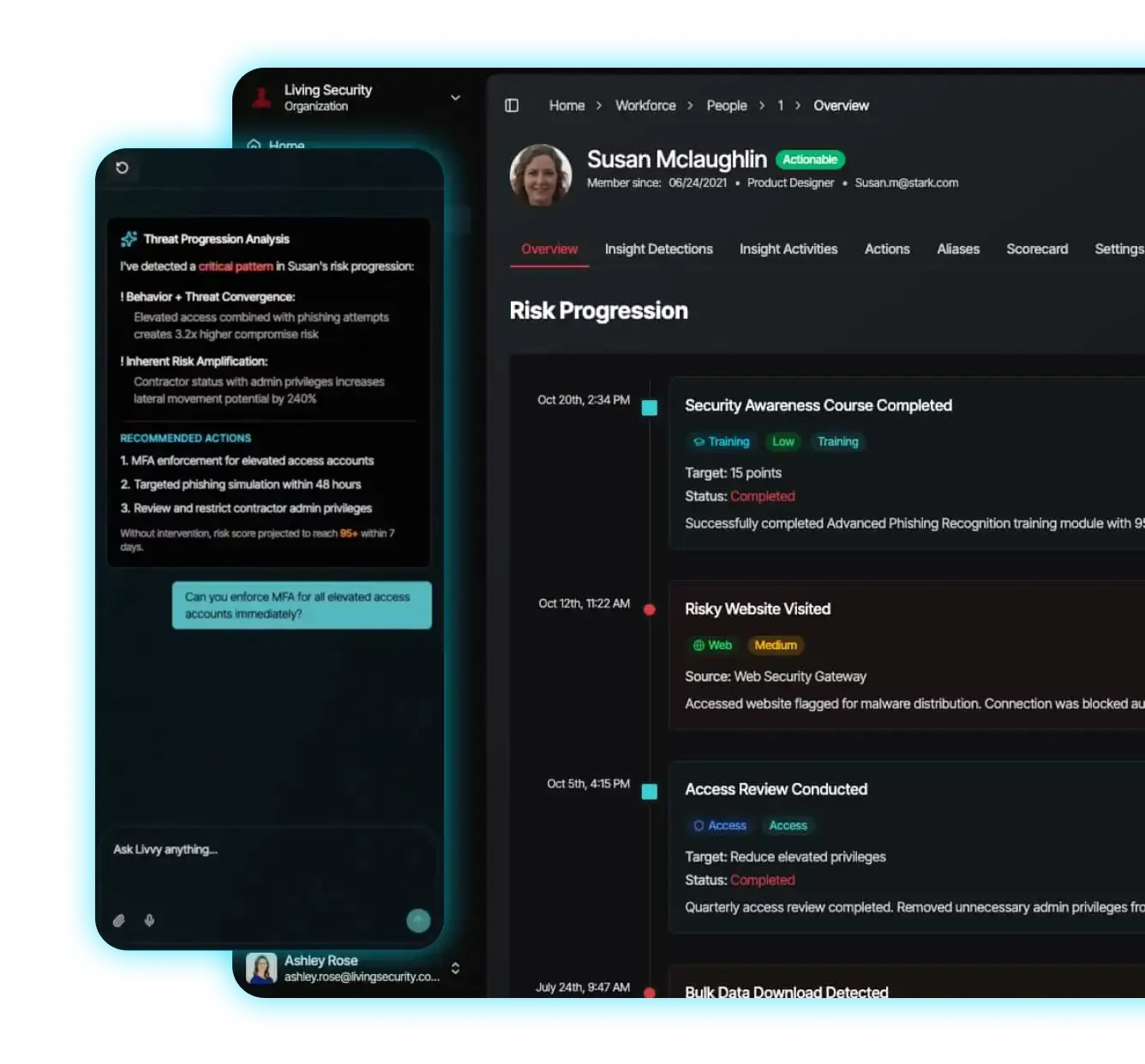
The types of human risk cybersecurity leaders track should reflect how exposure develops. They should not reflect only how an incident is recorded. A rushed click, an over-permissioned identity, a misplaced file, and an AI agent acting without sufficient boundaries can follow different paths to harm. When leaders group every event under human error, they lose the context needed to prioritize action.
See how Living Security helps security teams structure human risk
What Are the Types of Human Risk Cybersecurity Leaders Should Track?
Living Security defines the types of human risk cybersecurity leaders should track as six categories: phishing and social engineering. Credential and access misuse, data handling, insider behavior, process and human performance risk, and AI-agent misuse. Each category should be measured with behavior, identity, access, and threat context so leaders can guide safer actions without reducing people to a label.
Living Security, a leader in Human Risk Management (HRM), uses a people-first approach to connect those signals. The purpose is not to assign blame after an incident. It is to understand the conditions around a behavior, identify the earliest useful intervention, and measure whether that intervention reduces exposure.
This classification focus is distinct from a general introduction to Human Risk Management (HRM). A taxonomy gives security leaders a working model for organizing evidence, selecting interventions, and reporting change to executives.
Why classification improves security decisions
Different risk types have different owners, signals, and response options. A phishing pattern may call for reporting guidance and a safer message workflow. A privilege pattern may require identity controls or access review. A data-handling pattern may point to a confusing process, a missing guardrail, or a need for targeted guidance. Classification prevents a single training response from being applied to every problem.
How Do the Types of Human Risk Cybersecurity Shape Phishing Risk?
Phishing and social engineering risk occurs when a person is manipulated into taking an action that benefits an attacker or exposes an organization. The action may involve clicking a malicious link, approving an unexpected request, sharing information with an impersonator, or bypassing a verification step. Email remains important, but the category also includes voice scams, messaging platforms, collaboration tools, and business email compromise.
The useful unit of analysis is not simply whether someone clicked. Leaders should examine the message context, the requested action, the account or data involved, the reporting behavior, and what happened after the decision. A click that is immediately reported is different from a click followed by credential submission and delayed escalation. Those events should not produce the same conclusion or intervention.
How to measure phishing and social engineering risk
- Susceptibility: track clicks, replies, approvals, attachment opens, or other actions associated with controlled simulations and real events.
- Reporting behavior: measure whether people report suspicious messages, how quickly they report them, and whether reports contain useful context.
- Response quality: distinguish a safe pause, verification, escalation, or remediation action from a risky continuation.
- Exposure context: consider role, access, data handled, external communication patterns, and the potential impact of the requested action.
- Change over time: compare behavior before and after targeted guidance, workflow changes, or protective controls.
These measures are more actionable than a single pass or fail result. They help a security team determine whether the next step should be a message-reporting nudge. A change to an approval workflow, additional verification, or a review of access and data exposure.
For background on the human side of security outcomes, the NIST usability research on security behavior is a useful reminder that systems and processes shape decisions. The safest response is often to make the secure path clear and easy to follow.
How Should Leaders Measure Credential and Access Risk?
Credential and access risk describes exposure created by how identities are authenticated, privileged, shared, used, and removed. It can include weak authentication practices, credential reuse, unauthorized sharing, excessive permissions, stale accounts, unreviewed service access, or actions performed from an unusual context. The category crosses security awareness, identity, access governance, and incident response.
A credential event is not meaningful in isolation. A failed login from an unfamiliar location may be harmless. A successful login followed by unusual data access or privilege escalation deserves a different level of attention. Leaders should correlate identity signals with role, device, access rights, normal work patterns, and the sensitivity of the resources involved.
Measure the conditions around an identity event
| Signal group | What to examine | Useful leadership question |
|---|---|---|
| Authentication | Unusual attempts, repeated failures, unexpected factors, or bypasses | Where are stronger verification and clearer recovery paths needed? |
| Access level | Privilege, role changes, dormant access, and separation of duties | Do identities have more opportunity than their work requires? |
| Usage context | Device, location, time, application, and normal activity patterns | Which deviations need investigation or a safer default? |
| Human response | Reporting, approval behavior, credential handling, and escalation | Can people recognize and stop an access concern quickly? |
The objective is not to monitor people for its own sake. It is to identify where identity design, access policy, or workflow friction creates avoidable exposure. When the evidence points to excessive privilege, the intervention may be technical. When it points to confusing approval steps, the intervention may involve process design and focused guidance.
Separate opportunity from observed behavior
Access rights describe what an identity could do. Behavior shows what happened. Treating those as the same creates noisy reports. A high-privilege identity with ordinary usage may require a different plan from a lower-privilege identity repeatedly attempting sensitive actions. Reporting should show both opportunity and behavior, then add the potential impact of the resource involved.
How Do Data Handling and Insider Behaviors Differ?
Data-handling risk involves the ways people access, move, store, share, or dispose of information. The behavior may be accidental, such as sending a sensitive file to the wrong recipient. It may result from pressure or an unclear process, such as using an unsanctioned service to complete urgent work. It may also involve deliberate policy bypass or unauthorized data movement.
Insider behavior is a broader category that considers actions by people with legitimate access, including employees, contractors, and other trusted users. Insider risk may be negligent, compromised, or malicious. The category should not be inferred from one unusual event. Context, pattern, intent indicators, access history, and relevant changes in work circumstances matter.
Measure data exposure without assuming intent
- Data sensitivity: identify the type, volume, destination, and business impact of the information involved.
- Movement pattern: examine downloads, transfers, sharing, printing, removable media, and external destinations in context.
- Process fit: determine whether the action was part of a legitimate workflow or a workaround caused by friction.
- Pattern persistence: compare one event with repeated exceptions, escalating activity, or changes in normal behavior.
- Protective response: track whether a person reports a mistake, follows a correction, or continues an unsafe pattern.
CISA's insider threat guidance supports a coordinated approach that includes appropriate security, legal, privacy, and workforce stakeholders. A responsible program protects the organization while avoiding premature conclusions about a person's intent.
Use a fair investigation model
Start with the observable event. Add identity, access, data, and workflow context. Check whether the behavior is new, repeated, or connected to other signals. Then select a proportionate response. That response might be a correction, targeted guidance, access review, manager-supported process change, or a formal investigation. Documentation should explain why the action was selected and how the organization will assess whether it worked.
Where Does AI-Agent Misuse Fit in a Human Risk Taxonomy?
AI-agent misuse is an emerging type of human risk because people design, configure, approve, supervise, and rely on systems that can act at greater speed and scale. An agent may access data, call tools, create content, make recommendations, or trigger a workflow. The exposure can come from an unsafe prompt, excessive permission, unreviewed output, weak data boundary, or a human approval process that assumes the agent is correct.
This category includes both direct misuse and governance gaps. A person may connect an agent to a sensitive system without defining its limits. A team may accept generated content without checking its source or destination. An agent may also behave as configured while the surrounding workflow lacks logging, approval, or rollback. The responsible question is not whether AI is good or bad. It is where human decisions and system autonomy create measurable exposure.
Signals to track for AI-agent risk
- Which identities, applications, data stores, and tools an agent can access.
- Whether permissions are scoped to the agent's purpose and reviewed as workflows change.
- How often outputs are approved, edited, rejected, or escalated by a person.
- Whether sensitive data is included in prompts, outputs, logs, or downstream systems.
- Whether agent actions are traceable, reversible, and bounded by policy.
Living Security's AI-native HRM positioning centers on the modern workforce, which includes people and AI agents. Leaders can use the same core discipline for both: identify behavior, add context, predict where exposure may grow, and guide a proportionate action. The data model may differ, but the management goal remains measurable reduction of risk.
How Can Leaders Turn Risk Types Into a Working Program?
A taxonomy is useful only when it changes decisions. Leaders can move from categories to execution by assigning each type a definition, evidence set, intervention owner, and outcome measure. Start with the categories that matter most to the organization's exposure, rather than trying to measure every possible behavior at once.
- Define the category: describe the behavior or condition in plain language and specify what is outside its scope.
- Map the path to impact: connect the behavior to identity, access, data, systems, and likely business consequences.
- Select leading signals: choose observable actions that appear before a serious incident, such as repeated exceptions or delayed reporting.
- Choose an intervention: make the response fit the cause. Use guidance, workflow changes, access controls, or investigation when the evidence supports it.
- Measure the change: compare behavior and exposure after the intervention. Record what improved, what did not, and what should happen next.
Report categories without creating a blame system
Executive reporting should answer four questions: where is exposure concentrated, what context increases impact, what action is underway, and whether the action is working? A useful report can show category trends, affected workflows, access or data context, intervention status, and outcome measures. It should avoid ranking people for its own sake or presenting an unexplained number as a complete assessment.
MIT Sloan research on human performance in cybersecurity also reinforces why leaders should look beyond individual fault. Work design, incentives, tools, and organizational context influence whether secure behavior is practical. Category-level reporting gives leaders a way to address those conditions while still maintaining accountability for intentional misuse.
For teams building a broader people-centered program, the human risk definition guide can provide additional terminology. Living Security's platform overview explains how behavioral, identity, and threat signals can be brought together.
How Can Leaders Apply Types of Human Risk Cybersecurity Categories?
Leaders can apply types of human risk cybersecurity categories by assigning each category a clear definition, evidence set, intervention owner, and outcome measure. This structure turns disconnected events into a program that prioritizes exposure, guides proportionate action, and shows whether conditions improve.
A durable taxonomy should be specific enough to guide action and flexible enough to evolve. The categories in this guide provide a starting point, but each organization should adapt them to its workflows, technology, regulations, and exposure profile.
- Category definition: what behavior or condition is being measured?
- Scope and exclusions: which adjacent events belong elsewhere?
- Signal sources: which behavior, identity, access, data, and threat signals provide evidence?
- Impact context: what role, resource, process, or business outcome changes the potential harm?
- Intervention options: what can security, IT, managers, or process owners change?
- Success measure: what observable change will show that exposure has decreased?
Review the taxonomy periodically. New applications, distributed work, changing attack methods, and AI-agent adoption can create new pathways to exposure. A classification model should help leaders see those pathways earlier, not become a fixed list that no longer reflects the organization.
Request a demo to explore a more measurable approach to human risk
Frequently Asked Questions
What are the different types of human risk in cybersecurity?
The main types include phishing and social engineering, credential and access misuse, data handling, insider behavior, process and human performance risk, and AI-agent misuse. Organizations can combine or separate categories based on their workflows, but each type should have its own signals, context, intervention, and outcome measure.
How can cybersecurity leaders measure human risk?
Leaders can measure human risk by combining observable behavior with identity, access, data, threat, and workflow context. Useful signals include reporting, response quality, policy exceptions, unusual access, data movement, approval behavior, and changes after an intervention. Trends are more useful than isolated events.
Why should human risk be measured by category?
Different categories follow different paths to harm and require different interventions. A phishing pattern may call for safer reporting and verification, while excessive access may require a permission review. Category-level reporting helps leaders direct resources and explain whether an intervention is reducing exposure.
How should organizations address insider risk?
Organizations should use a multidisciplinary process that protects people while investigating credible signals. Review unusual access, policy bypass, data movement, work context, and repeated patterns together. Avoid inferring intent from one event, document decisions, and use proportionate safeguards with appropriate security, legal, privacy, and workforce support.