

Blogs  Non Human Identity Securi...
.jpeg?width=32&height=32&name=047-FjykSoq-Wa8%20(1).jpeg)
A leaked service-account credential does not need to fool an employee, pass an MFA challenge, or wait for business hours. It can enter as a trusted actor, reach sensitive systems, and execute at machine speed. Effective non human identity security gives enterprise teams the context to identify that exposure before a routine automation becomes an attack path.
Schedule a demo to make human and AI agent risk visible
What is non human identity security?
Non human identity security is the discipline of discovering, governing, monitoring, and retiring digital identities that operate without direct human action. It covers service accounts, workloads, API keys, OAuth applications, bots, certificates, and AI agents, with controls designed for their speed, scale, privileges, and machine-to-machine access patterns.
These identities are fundamental to modern operations. A workload authenticates to a database, an integration moves customer records, and an AI agent calls business systems to complete a task. Each action depends on a trust decision. The identity may be legitimate, yet its credential, permissions, or behavior can still create material exposure.
NIST defines a non-person entity as an entity with a digital identity that acts in cyberspace but is not a human actor. That definition establishes the category, but enterprise security requires more than an inventory. Teams need to know who owns each identity, why it exists, what it can access, how it normally behaves, and which threats could exploit it.
- Service accounts: Persistent identities used by applications, scheduled jobs, and infrastructure services.
- Workload identities: Identities assigned to containers, virtual machines, functions, and cloud-native services.
- Secrets and credentials: API keys, tokens, certificates, SSH keys, and other authentication material.
- OAuth applications and integrations: Third-party connections authorized to read, change, or transmit enterprise data.
- Bots and AI agents: Autonomous or semi-autonomous systems that can retrieve information, make decisions, and take actions.
The category is broad because attack paths cross systems. An employee may authorize an OAuth application, which uses a token to reach cloud data, which an AI agent then processes. Managing only the final machine identity misses the human decision and access chain that created its authority.
Why does NHI governance require a distinct operating model?
Human identity programs rely on predictable lifecycle events such as hiring, role changes, and departures. Machine identities often have no equivalent trigger. They can be created through code, replicated across environments, embedded in pipelines, or left active after an application is retired. Their owners may change while the credential remains untouched.
Traditional authentication controls also translate poorly. Machines cannot respond to a conventional MFA prompt, and always-on services may need continuous access. Security therefore depends on short-lived credentials, workload attestation, least privilege, automated rotation, ownership, and behavioral monitoring. Strong governance connects these controls to a broader view of AI agent risk management rather than treating every machine credential as an isolated technical issue.
Why is non-human identity risk accelerating?
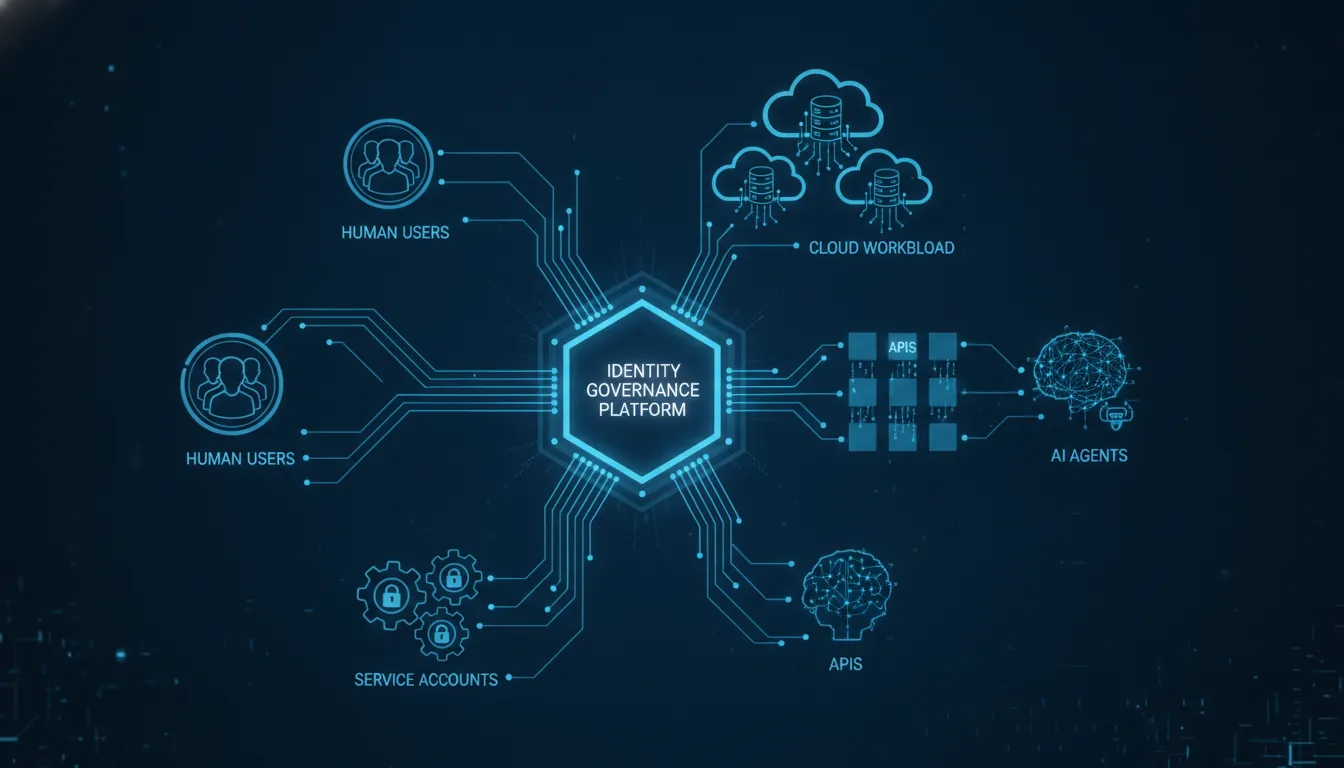
Non-human identity risk is accelerating because cloud services, automation, integrations, and AI agents create identities faster than manual governance can review them. These actors often hold persistent privileges across high-value systems. When ownership, credential hygiene, and behavioral context are fragmented, a single compromised identity can become a quiet, scalable attack path.
Standing privilege creates durable attack paths
A service account may need to read one data set during a nightly job but retain broad permissions around the clock. If its secret leaks, an attacker inherits trusted access with no need to exploit a vulnerability in the target system. Long-lived tokens make the window worse because a forgotten credential can remain useful after its original project ends.
Least privilege must therefore consider resources, actions, environments, and time. A technically valid identity can still be risky when it accesses an unusual resource, operates from an unexpected location, or changes its activity after months of consistency. Those signals matter more when correlated than when reviewed as separate alerts.
AI agents increase autonomy and consequence
AI agents differ from conventional scripts because they can interpret goals, select tools, and take a sequence of actions. Their authority may combine a model's decision-making with the permissions of connected applications. A poorly governed agent can expose sensitive information or execute an unsafe action even when its underlying credentials function exactly as configured.
The challenge is not to prevent enterprise adoption. It is to establish accountable deployment. Living Security's Human-AI Cyber Risk Management Framework provides a model for governing humans and AI agents as one connected workforce. This broader view helps security leaders assess how people authorize agents, how agents use access, and where threat activity intersects with both.
Fragmented ownership hides systemic exposure
Identity teams may manage directories, cloud teams may manage workload roles, developers may own secrets, and business teams may authorize SaaS integrations. Each group can operate its own control effectively while the organization still misses cross-system risk. An OAuth token that looks routine to one team may provide the bridge between a compromised user and sensitive cloud data.
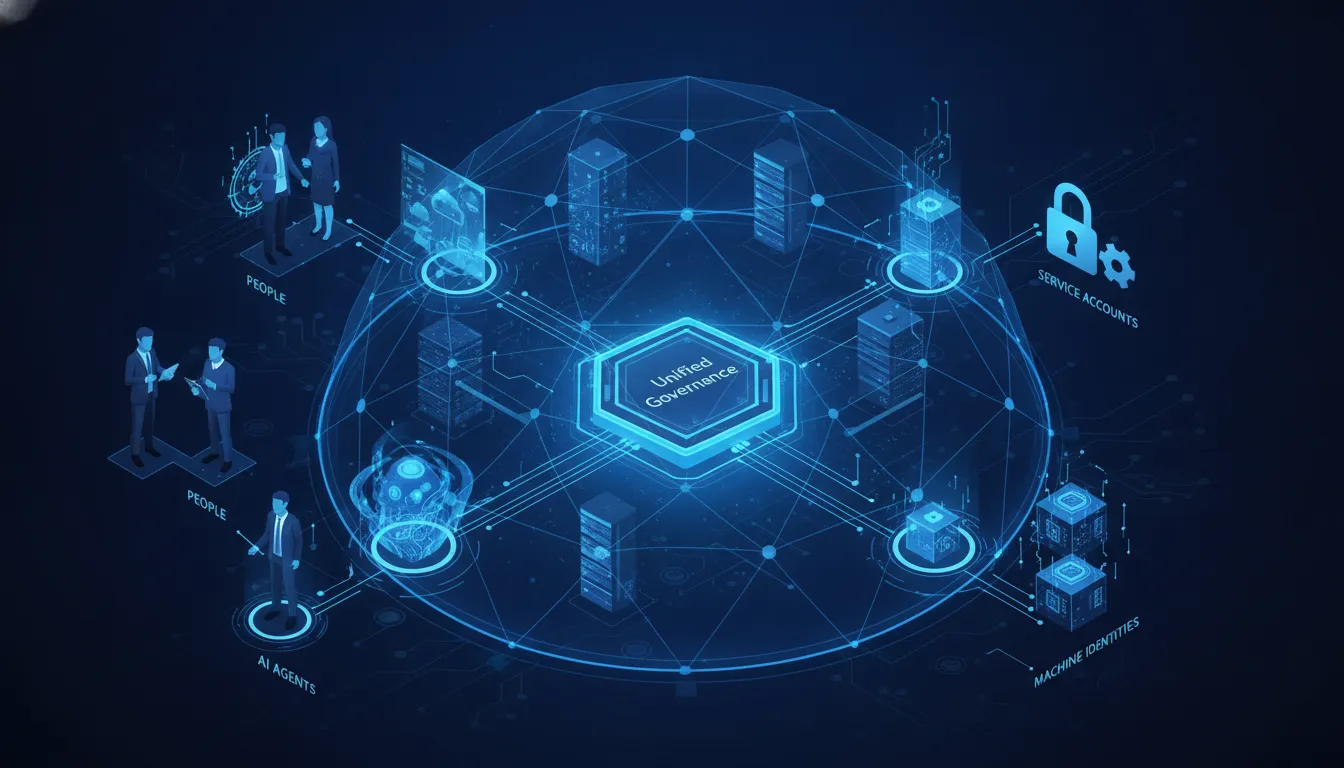
A unified governance model for humans and agents makes those relationships explicit. It assigns accountability without assuming one team can own every control. Security leaders gain a shared language for reviewing access, behavior, and threat context across the complete chain.
How does non-human identity security differ from human identity security?
Human and non-human identity security share core principles, including verified identity, least privilege, accountable ownership, and continuous monitoring. They differ in lifecycle, authentication, scale, and behavior. People follow organizational events and work patterns, while machine identities can be created through code, run continuously, replicate rapidly, and authenticate through secrets or certificates.
| Control dimension | Human identities | Non-human identities | Enterprise security implication |
|---|---|---|---|
| Lifecycle. | Hiring, role change, departure. | Code deployment, service change, integration retirement. | Automate discovery and decommissioning triggers. |
| Authentication. | Passwords, passkeys, MFA. | Tokens, keys, certificates, workload identity. | Favor short-lived credentials and attestation. |
| Typical activity. | Interactive and time-bound. | Continuous, high-volume, and machine-speed. | Baseline expected behavior and detect deviations. |
| Ownership. | Named individual and manager. | Application, team, vendor, or agent sponsor. | Assign a named accountable owner for every identity. |
| Primary exposure. | Phishing, unsafe actions, credential compromise. | Leaked secrets, excessive privilege, orphaned access. | Correlate behavior, identity and access, and threat signals. |
Where the two risk domains converge
Attackers do not respect organizational control boundaries. A phishing attack can compromise an employee who approves a malicious OAuth application. That application can use its non-human identity to access data and create another credential for persistence. The resulting chain includes human behavior, machine access, and active threat evidence.
This is why NHI controls should complement, not replace, Human Risk Management. HRM, as defined by Living Security, correlates behavior, identity and access, and threat. It makes risk visible, measurable, and actionable across people and AI agents while specialized IAM, secrets management, and cloud security tools continue enforcing their respective controls.
See how Living Security connects risk signals across your workforce
Which attack paths should security leaders prioritize?
Security leaders should prioritize non-human identity attack paths with broad privileges, weak ownership, exposed or long-lived credentials, and access to sensitive data. The highest-risk paths often connect multiple domains, such as a compromised employee authorizing an application, a leaked service credential reaching production, or an unmanaged AI agent acting through trusted integrations.
Leaked service credentials and embedded secrets
Secrets can escape through public repositories, internal code, logs, tickets, container images, or configuration backups. Scanning helps locate exposed material, but revocation speed and downstream analysis determine whether the response contains risk. Teams must identify every resource the credential could reach, review its activity, rotate related secrets, and fix the process that exposed it.
Orphaned accounts and excessive permissions
An identity without a current owner is difficult to validate and easy to ignore. Orphaned service accounts often survive application migrations, reorganizations, and vendor changes. Excess permissions compound the problem by giving an attacker more options after compromise. Prioritization should combine ownership status, privilege, credential age, resource sensitivity, and observed behavior rather than relying on any single factor.
OAuth grants, shadow automation, and agent tool use
Business users can create machine access simply by approving an application. The initial grant may appear harmless, yet later scope changes, vendor compromise, or unsafe agent use can alter the risk. Governance should inventory grants, validate business purpose, constrain scopes, monitor activity, and require reassessment when the connected application or its owner changes.
Zero Trust reinforces this approach. NIST states that Zero Trust focuses on protecting resources rather than trusting a network location, and its architecture applies authentication and authorization decisions before access to enterprise resources. Reviewing the NIST Zero Trust Architecture helps teams align NHI controls with resource-level policy and continuous evaluation.
How can enterprises build a non-human identity security program?
Enterprises can build a non-human identity security program by combining complete discovery, accountable ownership, lifecycle governance, least privilege, continuous risk analysis, and measured remediation. The program should integrate existing IAM, PAM, secrets, cloud, and threat tools, then connect machine exposure to the broader human and AI agent risk picture.
A practical program is not a single product deployment. Dedicated identity and access tools enforce machine controls, while enterprise risk operations determine which exposures demand action first. Living Security is not a dedicated NHI or IAM product. As the first AI-native Human Risk Management platform, it adds cross-domain context that helps teams prioritize and reduce risk across humans and AI agents.
1. Discover identities and map dependencies
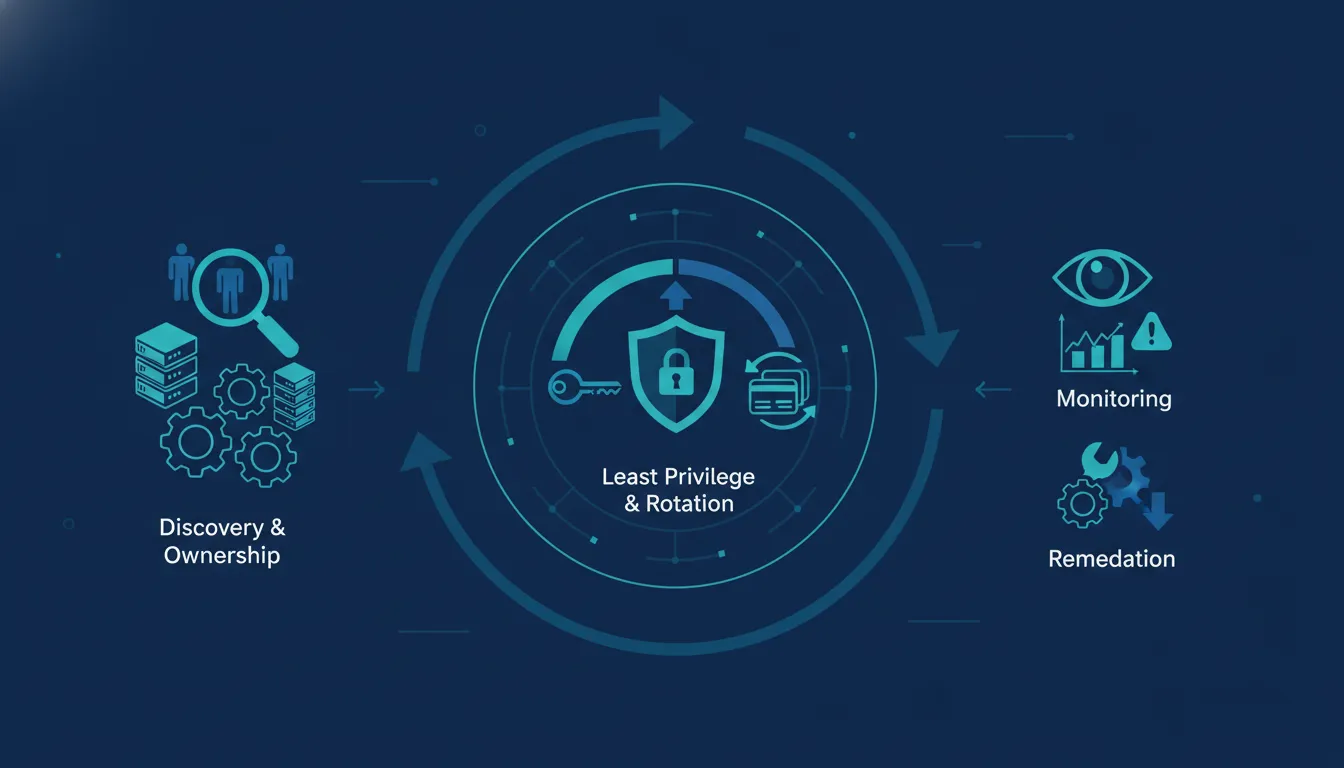
Build an inventory across cloud platforms, directories, source repositories, secrets stores, SaaS applications, endpoints, and security tools. Record each identity's owner, purpose, authentication method, privileges, dependencies, data access, and expected lifetime. Discovery must be continuous because infrastructure-as-code and AI adoption can create new identities between periodic reviews.
2. Assign owners and govern the lifecycle
Require a named human owner and business purpose for every non-human identity. Define standards for creation, approval, rotation, reassessment, and retirement. Link decommissioning to application and vendor lifecycle events, not just employee departures. Exceptions should expire automatically and return to an owner for review.
- Discover: Maintain a continuously updated inventory.
- Govern: Assign ownership, purpose, and lifecycle rules.
- Reduce: Limit privilege and credential lifetime.
- Measure: Track verified reductions in exposure.
3. Reduce privilege and credential lifetime
Replace static credentials with short-lived, automatically issued credentials where feasible. Restrict access by resource, environment, action, and time. Separate development and production identities, remove unused permissions, and test whether services still operate after rightsizing. The objective is to reduce both the likelihood of compromise and the potential blast radius.
4. Correlate risk and prioritize remediation
Raw alerts do not tell leaders which identity creates the greatest business risk. Prioritization needs context from behavior, identity and access, and threat. Living Security, a pioneer and leader in HRM, analyzes 200+ risk indicators through 60+ security tool integrations. Its intelligence is grounded in five years of proprietary data and billions of signals from 100+ enterprises.
That context helps teams distinguish an old but tightly constrained certificate from an overprivileged service account showing suspicious activity. Livvy, Living Security's always-on intelligence engine and AI guide, uses AI with human oversight to provide explainable recommendations and act on routine remediation while security teams remain in control. Livvy can automate 60-80% of routine remediation tasks.
5. Measure outcomes, not inventory volume
Track the percentage of identities with validated owners, high-risk privileges removed, secrets converted to short-lived credentials, orphaned access retired, and critical findings remediated within target timeframes. Also measure business outcomes such as reduced attack-path exposure and faster response. An inventory is only valuable when it drives verified risk reduction.
Independent Cyentia Institute research validated outcomes from Living Security that include a 50% reduction in risky users and a 98% decrease in data-loss exposure. These results demonstrate the value of moving beyond checkbox compliance toward predictive, measurable risk reduction. They should not be interpreted as a substitute for the specialized controls required to secure every machine identity.
How does Human Risk Management strengthen NHI governance?
Human Risk Management strengthens NHI governance by revealing how people, machine access, and active threats combine into enterprise risk. It does not replace IAM or secrets management. It correlates behavior, identity and access, and threat signals so security teams can prioritize the human and AI agent relationships most likely to produce an incident.
This connected approach helps CISOs, GRC leaders, security awareness teams, and SOC teams operate from a shared risk model. It also supports the shift from reactive, compliance-driven training to proactive prevention. The Living Security platform helps teams turn fragmented security telemetry into explainable priorities and targeted action.
Frequently asked questions about non human identity security
These answers clarify the core decisions enterprise leaders face when establishing non human identity security. They cover the identities in scope, the relationship to IAM, the need to govern AI agents, and the metrics that indicate whether a program is reducing exposure rather than simply producing a larger inventory.
What is a non-human identity?
A non-human identity is a digital identity used by an entity that acts in cyberspace without being a human user. Examples include service accounts, workloads, API keys, certificates, bots, OAuth applications, and AI agents. Each identity should have an approved purpose, accountable owner, constrained access, and governed lifecycle.
Is non human identity security the same as IAM?
No. IAM provides essential authentication, authorization, and lifecycle controls, but non human identity security also requires secrets management, workload identity, behavioral monitoring, threat context, and machine-specific governance. The strongest programs integrate these capabilities and use enterprise risk context to prioritize the exposures with the highest potential consequence.
Why must AI agents be included in NHI governance?
AI agents can select tools, retrieve information, and take actions through trusted integrations. Their autonomy and access can create consequences beyond those of a fixed script. Governance should define an owner, approved purpose, permissions, monitoring, intervention boundaries, and retirement process for every enterprise agent.
Which metrics show that an NHI security program works?
Useful metrics include ownership coverage, orphaned identities retired, excessive privileges removed, credential lifetime reduced, critical findings remediated on time, and high-risk attack paths eliminated. Leaders should connect these operational measures to outcomes such as reduced data-loss exposure, faster response, and fewer unmanaged connections to sensitive resources.
Non human identity security is most effective when every machine identity is governed in its own lifecycle and evaluated within the complete enterprise risk picture. By connecting specialized NHI controls with Human Risk Management, security leaders can see how people and AI agents create exposure, focus teams on consequential attack paths, and prevent incidents before trusted access becomes a weapon.
Request a Living Security demo to connect human and AI agent risk
.jpeg?width=200&height=200&name=047-FjykSoq-Wa8%20(1).jpeg)


