Whitepaper · Vol. 01 — AI & HRM 18 MIN READ

The Human Risk Layer of AI.

Why securing LLMs requires more than technical controls — and how Human Risk Management closes the gap between what AI can do and what the workforce will do.

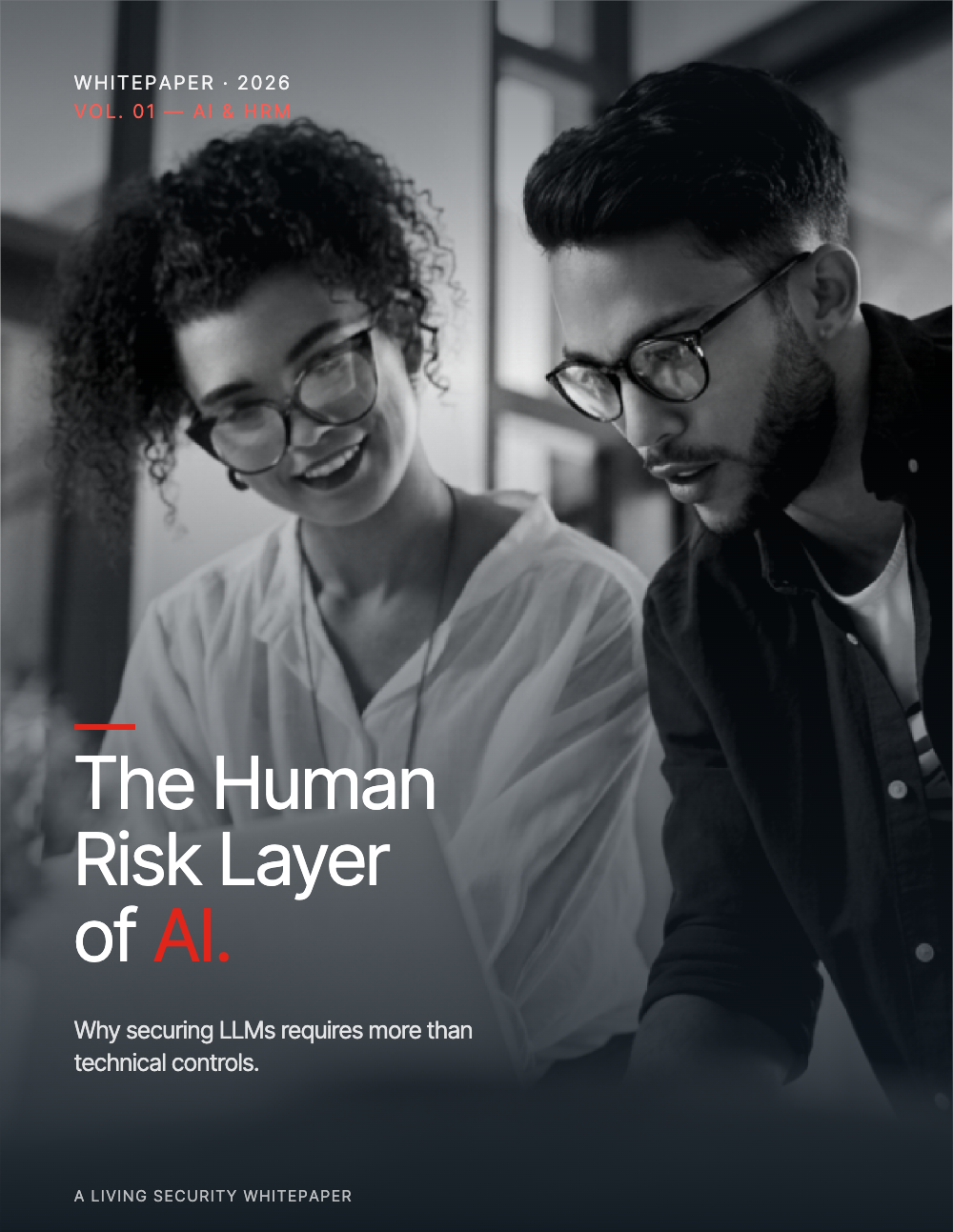
Cover of The Human Risk Layer of AI whitepaper
Free report

Get your copy

Complete the form for instant access to all 16 pages — no wait, no follow-up call required.

Your information is secure and never shared.
88%of organizations use gen AI in at least one function.McKinsey, 2025
10/7310% of users drive 73% of organizational risk.Cyentia · Living Security, 2025
1,265%surge in AI-linked phishing since 2023.SlashNext, 2023
What you'll learn

Four things you'll take from this report.

The six categories of human–AI interaction risk — from data exposure to synthetic identity.
Why annual, one-size-fits-all awareness training is structurally outmatched by AI-era threats.
The Predict · Guide · Act operating model for continuous, identity-aware risk reduction.
Five strategic moves CISOs can make to produce measurable risk reduction in 12 months.
Inside the report

Nine sections. One argument: AI risk is a human problem.

Written for CISOs and AI governance leaders. Grounded in five years of telemetry across 100+ enterprises and 300+ behavioral signals.

01
Executive summaryThe largest emerging attack surface in enterprise AI is not the model.
02
The enterprise AI explosionBottom-up adoption that has outpaced every prior platform shift.
03
The new human attack surfaceSix categories of human–AI interaction risk.
04
Why traditional models failAnnual training cannot move at the pace of weekly threats.
05
HRM for the AI eraIdentify. Understand. Adapt.
06
The future of AI defense is adaptiveEmbrace adoption; pair it with workforce visibility.
07
Strategic recommendations for CISOsFive moves that produce measurable reduction in 12 months.
08
The workforce of the future is hybridHumans and the AI agents acting on their behalf — one risk surface.
09
Conclusion · About · SourcesThe future of AI security is not just technical. It is human.
The thesis of this paper

Technical controls govern what an AI system can do. Human Risk Management governs what the workforce — humans and the agents acting on their behalf — will do.

The framework

Predict. Guide. Act.

How Living Security manages human risk in the AI era — the operating model the whitepaper details in full.

Step 01

Predict

Continuously identify and quantify human risk across behavior, access, and threat. Telemetry, not surveys.

Step 02

Guide

Turn risk intelligence into clear, actionable guidance — where risk is concentrated, why, and what to do next.

Step 03

Act

Reduce risk through adaptive intervention. The right action, to the right person, at the right time.

What good looks like

Customer outcomes, measured in 12 months.

50%fewer risky users within 12 months of program launch.
60%faster remediation across the highest-priority risks.
98%reduction in data-loss exposure among the highest-risk users.
Named a Leader in The Forrester Wave™: HRM · Trusted by
UNILEVERMASTERCARDMERCKABBOTT

Read the report. Then see your own numbers.

See where your workforce concentrates AI risk. Request a Human Risk benchmark from Living Security.

Get your copy Request a benchmark