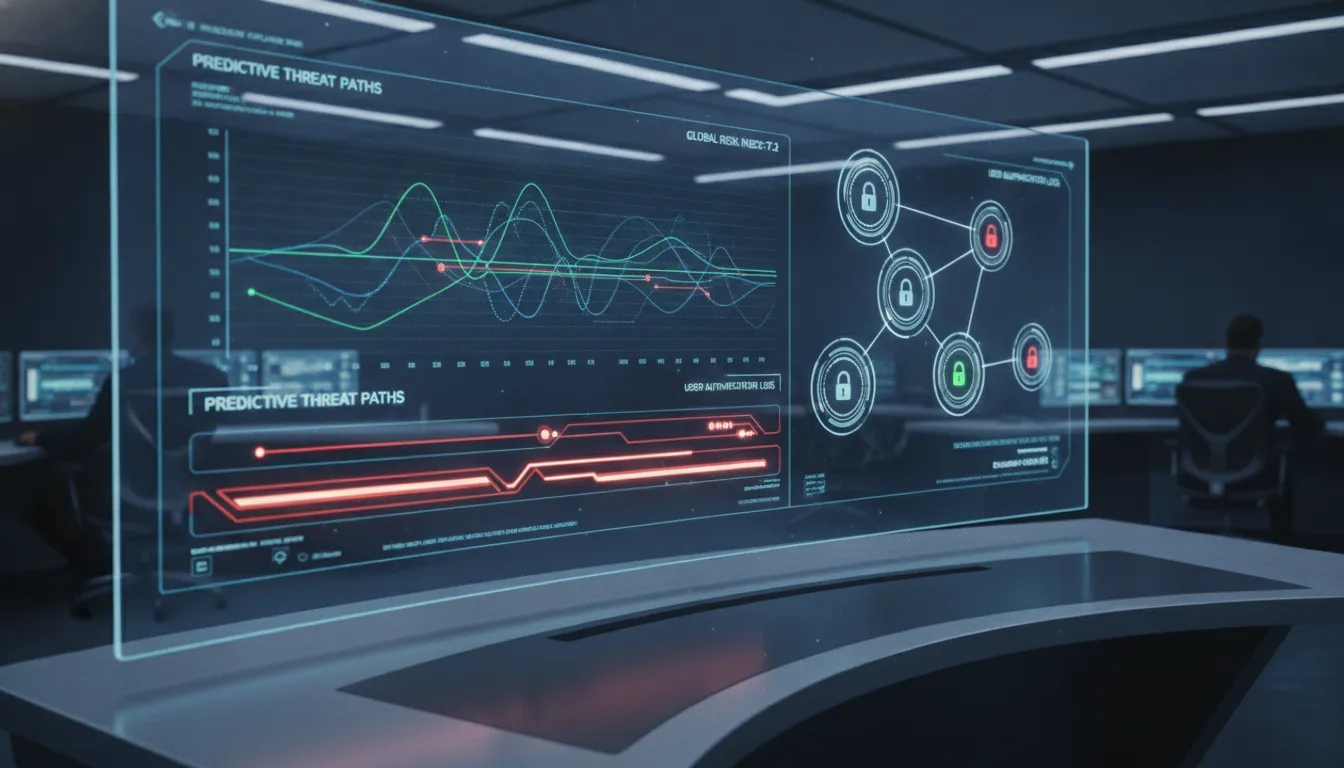
Understanding how AI is changing insider risk management has become a strategic priority for CISOs. Insider risk rarely appears as one conclusive alert. It develops across identity changes, unusual access, shifting behavior, and active threats. AI can correlate those signals, establish context, and predict where intervention is most likely to prevent an incident. The result is a decisive move from reactive investigation toward measurable Human Risk Management (HRM).
This change is not simply about processing alerts faster. It reshapes the operating model for insider risk. Security teams can focus limited expertise on consequential cases, orchestrate targeted interventions, and measure whether risk actually declines. AI with human oversight also helps enterprises apply those capabilities without surrendering governance, fairness, or accountability.
How AI is changing insider risk management
AI is changing insider risk management by replacing isolated, rules-based alerts with predictive intelligence. Rather than judging one event against a fixed threshold, AI evaluates relationships among behavior, identity and access, and threat signals. It can identify a pattern that appears benign in one system but becomes material when correlated across the enterprise.
That distinction matters because insider risk includes malicious activity, negligence, compromised credentials, and mistakes made under pressure. A large file transfer may be legitimate for one employee and anomalous for another. A new login location may reflect travel, or it may indicate an account takeover. Context determines which action deserves attention.
From alert volume to decision quality
Traditional controls often force analysts to investigate events individually. That operating model increases noise and makes it difficult to distinguish meaningful changes from routine work. AI can establish dynamic baselines, evaluate signal combinations, and surface the evidence behind a recommendation. Analysts receive a prioritized decision point rather than another undifferentiated alert.
Human Risk Management (HRM), as defined by Living Security, extends this approach beyond detection. The objective is to make human risk visible, measurable, and actionable, then reduce it through precise interventions. This connects insider-risk operations to outcomes that matter to executive teams: fewer risky users, lower data-loss exposure, and stronger control over emerging threats.
From hindsight to prediction
Rules describe conditions that have already been recognized. Predictive models can identify combinations and trajectories that have not yet crossed a static threshold. This enables earlier action, especially when a series of individually low-severity events creates a high-confidence pattern.
For a practical view of the underlying model, see Living Security's guide to predictive analytics for insider threats. The strategic advantage is not prediction for its own sake. It is the additional time security teams gain to guide a user, adjust access, or escalate a case before exposure becomes an incident.
Why contextual intelligence outperforms static rules
A static rule asks whether an event exceeded a predefined limit. Contextual intelligence asks whether the event is meaningful for this identity, at this time, given current access and threat conditions. That shift materially improves the quality of insider-risk decisions.
| Capability | Static rules | AI-native contextual intelligence |
|---|---|---|
| Signal analysis. | Evaluates events independently. | Correlates behavior, identity and access, and threat data. |
| User context. | Applies fixed thresholds. | Uses dynamic baselines and changing business context. |
| Analyst experience. | Produces high-volume alerts. | Prioritizes evidence-backed recommendations. |
| Response model. | Investigates after conditions are met. | Guides targeted action before risk escalates. |
| Measurement. | Counts alerts and completions. | Tracks changes in risky populations and exposure. |
Correlation across the security ecosystem
AI becomes more useful as its context improves. An enterprise program should correlate signals across security, identity, access, and business systems rather than depend on a single source. Living Security analyzes more than 200 risk indicators and connects with more than 60 security tools. This allows the platform to evaluate a person's actions alongside what they can access and which threats are active.
That unified context also supports more defensible decisions. When legal, privacy, HR, or incident-response teams review a case, they need to understand why it was escalated. Explainable recommendations, supported by relevant evidence, make AI useful in a governed enterprise workflow rather than an opaque black box.

What can AI identify that traditional controls miss?
AI is particularly valuable when risk emerges gradually or crosses multiple systems. Traditional controls may see each event, yet fail to recognize the sequence. Predictive intelligence can evaluate weak signals together and identify changes that merit action.
Subtle changes in legitimate access
Many insider-risk scenarios involve valid credentials and authorized access. The concern is not whether a person could reach the data, but whether current use is inconsistent with role, history, and business need. AI can identify unusual access sequences, atypical file movement, or a meaningful change in working patterns without assuming that every anomaly is malicious.
Compromised identities and synthetic activity
Compromised accounts can resemble legitimate users long enough to evade basic controls. AI can compare activity with established patterns and related threat intelligence to reveal inconsistencies. It can also help organizations address risks from AI agents that access systems, handle data, or act on a person's behalf. Modern insider-risk programs must govern both human and non-human actors.
Signals that become material only in combination
A role change, access to a new repository, and unusual data movement may each have a reasonable explanation. Together, they may require review. AI can identify those combinations at enterprise scale and explain the contributing factors, allowing analysts to assess the case with appropriate business context.
How does AI improve insider-risk response?
Prediction creates value only when it leads to effective action. AI improves response by recommending an intervention suited to the person, the behavior, and the potential impact. It can also act on routine remediation while preserving human control over consequential decisions.
Targeted intervention instead of blanket training
Annual awareness programs treat broad populations similarly, regardless of current risk. An AI-native approach can guide the right intervention to the right person at the right time. A low-severity mistake may warrant a concise coaching moment. A pattern involving sensitive data and unusual access may require analyst review or a control adjustment.
This is where insider-risk management connects to a broader Human Risk Management program. Training remains useful, but it becomes one option within a measurable risk-reduction strategy rather than the entire strategy.
Autonomous action with human oversight
Living Security's Livvy is an always-on intelligence engine and AI guide built on proprietary HRM data. Livvy predicts emerging threats, explains recommendations, and acts on routine remediation while keeping security teams in control. That human-in-the-loop model is essential when an intervention could affect access, employment, or a formal investigation.
AI can autonomously handle 60 to 80 percent of routine remediation tasks, allowing specialists to focus on high-impact cases and policy decisions. Independent Cyentia Institute research has also validated outcomes including a 50 percent reduction in risky users and a 98 percent decrease in data-loss exposure. Those measures show why mature programs evaluate risk reduction, not simply activity volume.
Why human oversight remains non-negotiable
AI can reveal patterns at a scale no analyst team can match, but it cannot own institutional accountability. Insider-risk decisions involve privacy, proportionality, workforce trust, and legal obligations. Human oversight ensures that recommendations are interpreted within those constraints.
Explainability supports defensible decisions
Security leaders should expect every high-impact recommendation to include evidence and reasoning. Explainability helps analysts challenge assumptions, distinguish correlation from causation, and document why an intervention was appropriate. It also allows leaders to evaluate whether the system performs consistently across business units and populations.
Governance protects trust
A responsible program defines what data can be used, who may review it, how long it is retained, and which actions require approval. These guardrails should cover both people and AI agents. Security, legal, privacy, HR, and business leaders need a shared operating model before autonomous actions expand.
The principle is straightforward: use AI to increase the speed and quality of judgment, not to eliminate judgment. That approach supports innovation without turning insider-risk management into indiscriminate workforce surveillance.
How should CISOs adopt AI for insider risk?
CISOs should treat AI adoption as an operating-model change, not a tool deployment. A disciplined rollout starts with measurable outcomes, governed data, and a bounded use case. It then expands as teams validate performance and build confidence.
- Define the outcome. Select a board-relevant result, such as reducing risky users or lowering data-loss exposure. Avoid making alert volume the primary measure of success.
- Unify the necessary context. Connect behavior, identity and access, and threat signals required for the initial use case. Document ownership and quality for each source.
- Establish governance. Define review rights, privacy controls, escalation criteria, and the actions AI may take autonomously.
- Pilot a consequential use case. Focus on a scenario where better prioritization or earlier intervention can produce a measurable operational benefit.
- Measure, learn, and scale. Evaluate prediction quality, analyst efficiency, intervention outcomes, and changes in exposure before expanding.
Questions leaders should ask vendors
- Which signals inform each recommendation, and can analysts inspect the reasoning?
- Does the system correlate behavior, identity and access, and threat data?
- How does the platform govern risks from both people and AI agents?
- Which actions require human approval, and which can occur autonomously?
- How are outcomes measured beyond alerts, completions, or activity counts?
Organizations evaluating an AI-native approach can also review how a Human Risk Management system uses AI to connect prediction, guidance, and action.
The future of insider risk is measurable Human Risk Management
AI is moving insider-risk management from fragmented detection toward coordinated prevention. It gives enterprises the ability to interpret complex signal relationships, predict emerging risk, guide precise interventions, and measure the result. The most effective programs will combine that intelligence with transparent governance and expert human oversight.
Living Security, a leader in Human Risk Management (HRM), brings those capabilities together in the first AI-native Human Risk Management platform. Its approach correlates behavior, identity and access, and threat signals, then helps teams predict, guide, and act before risk becomes an incident.
Frequently asked questions
How is AI used in insider risk management?
AI correlates behavior, identity and access, and threat signals to identify meaningful changes, predict emerging risk, and recommend targeted interventions. It helps analysts prioritize consequential cases while autonomously handling routine remediation under defined controls.
Can AI prevent insider threats?
AI can help prevent incidents by identifying risk trajectories earlier and guiding action before exposure escalates. It does not eliminate insider risk, and high-impact decisions still require human oversight, governance, and appropriate business context.
What is the difference between user behavior analytics and Human Risk Management?
User behavior analytics primarily evaluates activity patterns. Human Risk Management connects behavior with identity and access, active threats, targeted interventions, and measurable outcomes. It is an operating model for predicting and reducing risk, not simply observing it.
How should organizations govern AI in insider-risk programs?
Organizations should define permitted data, review rights, retention, escalation criteria, privacy controls, and which actions require human approval. Governance should also cover the activities and access of AI agents, not only employees and contractors.
Which outcomes should CISOs measure?
CISOs should prioritize reductions in risky populations and data-loss exposure, along with prediction quality, analyst efficiency, and intervention effectiveness. These measures are more useful than alert counts because they show whether the program reduces enterprise risk.